


Page 362 - Towards Trustworthy Elections New Directions in Electronic Voting by Ed Gerck (auth.), David Chaum, Markus Jakobsson, Ronald L. Rivest, Peter Y. A. Ryan, Josh Benaloh, Miroslaw Kutylowski, Ben Adida ( (z-lib.org (1)
P. 362
M. Kutyłowski and F. Zagórski
                          354
                          instance, if the voter is using an electronic ID card or ID codes that are used also for
                          other purposes (like submitting a tax declaration).
                            Even if Alice casts the vote herself, she can record the whole voting session and
                          present it to the buyer together with the ballot and the coding card used. The ballots
                          have a non-electronic, paper form, so they can be presented to the remote buyer as
                          electronic copies. However, the scan of the ballot can be manipulated and the coding
                          card presented needs not to be the one actually used.
                            Things become more complicated for the buyer, if the authentication protocol is
                          based on a zero-knowledge protocol – then the buyer cannot be even sure that the voter
                          is casting a vote unless he is controlling directly the voter’s PC.
                            The only thing that the buyer can be convinced about is the receipt and the matching
                          entries in the bulletin board. However, at this moment we fall back to the case of the
                          external observer considered above.
                          Decoy service. Decoy service can be optionally launched in order to make vote-buying
                          and coercion harder. A voter can visit a webpage of a decoy service and download fake
                          coding card with any given serial number and arbitrarily chosen arrangement of Y’s and
                          n’s. Then, the voter may present such a coding card to a coercer or a vote buyer together
                          with a receipt and ballot to prove that she voted in a certain way.

                          Usability issues. The scheme might be uneasy to use at least for two reasons. First, a
                          voter needs to click next to every candidate. Second, a voter needs to find her candidate
                          on a permuted list of candidates. So use of shifted lists of candidates (as for Prêt à Voter)
                          can improve usability. Unfortunately, shifts have bad impact of privacy.
                            A receipt obtained by a voter is an k-row column. If permutations are used for re-
                          ordering lists of candidates, then there are k + 1 types of of receipts (any two receipts
                          with the same number of × marks are equivalent).
                            The situation is different, if shifts are used. Then, the number of different types of
                          receipts is equal to the number of k-bead necklaces with 2 colors which equals to (see

                                              k
                          [8]): S(k) =  1 k  d|k  ϕ(d)2 d , where ϕ(k) is the Euler quotient function, i.e. for k-prime
                                  k
                          S(k) = 2 /k. In this case, in order to achieve privacy of votes, the number of voters
                          has to be much higher than S(k). The other solution to this problem is to use so called
                          masked ballot columns.
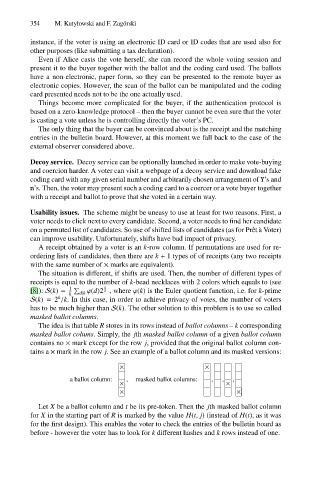
                            The idea is that table R stores in its rows instead of ballot columns – k corresponding
                          masked ballot colums. Simply, the jth masked ballot column of a given ballot column
                          contains no × mark except for the row j, provided that the original ballot column con-
                          tains a × mark in the row j. See an example of a ballot column and its masked versions:

                                                   ×                      ×
                                     a ballot column:  ,  masked ballot columns:  ,  ,  ,
                                                   ×                            ×
                                                   ×                               ×
                            Let X be a ballot column and t be its pre-token. Then the jth masked ballot column
                          for X in the starting part of R is marked by the value H(t, j) (instead of H(t), as it was
                          for the first design). This enables the voter to check the entries of the bulletin board as
                          before - however the voter has to look for k different hashes and k rows instead of one.

