


Page 399 - Towards Trustworthy Elections New Directions in Electronic Voting by Ed Gerck (auth.), David Chaum, Markus Jakobsson, Ronald L. Rivest, Peter Y. A. Ryan, Josh Benaloh, Miroslaw Kutylowski, Ben Adida ( (z-lib.org (1)
P. 399
391
                                          Aperio: High Integrity Elections for Developing Countries


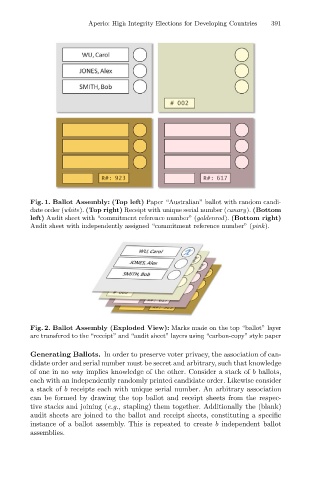
                          Fig. 1. Ballot Assembly: (Top left) Paper “Australian” ballot with random candi-
                          date order (white). (Top right) Receipt with unique serial number (canary). (Bottom
                          left) Audit sheet with “commitment reference number” (goldenrod). (Bottom right)
                          Audit sheet with independently assigned “commitment reference number” (pink).


                          Fig. 2. Ballot Assembly (Exploded View): Marks made on the top “ballot” layer
                          are transfered to the “receipt” and “audit sheet” layers using “carbon-copy” style paper

                          Generating Ballots. In order to preserve voter privacy, the association of can-
                          didate order and serial number must be secret and arbitrary, such that knowledge
                          of one in no way implies knowledge of the other. Consider a stack of b ballots,
                          each with an independently randomly printed candidate order. Likewise consider
                          astack of b receipts each with unique serial number. An arbitrary association
                          can be formed by drawing the top ballot and receipt sheets from the respec-
                          tive stacks and joining (e.g., stapling) them together. Additionally the (blank)
                          audit sheets are joined to the ballot and receipt sheets, constituting a specific
                          instance of a ballot assembly. This is repeated to create b independent ballot
                          assemblies.

