


Page 1211 - (ISC)² CISSP Certified Information Systems Security Professional Official Study Guide
P. 1211
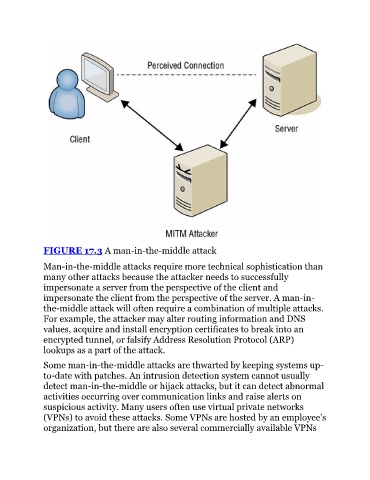
FIGURE 17.3 A man-in-the-middle attack

               Man-in-the-middle attacks require more technical sophistication than
               many other attacks because the attacker needs to successfully
               impersonate a server from the perspective of the client and

               impersonate the client from the perspective of the server. A man-in-
               the-middle attack will often require a combination of multiple attacks.
               For example, the attacker may alter routing information and DNS
               values, acquire and install encryption certificates to break into an
               encrypted tunnel, or falsify Address Resolution Protocol (ARP)
               lookups as a part of the attack.

               Some man-in-the-middle attacks are thwarted by keeping systems up-

               to-date with patches. An intrusion detection system cannot usually
               detect man-in-the-middle or hijack attacks, but it can detect abnormal
               activities occurring over communication links and raise alerts on
               suspicious activity. Many users often use virtual private networks
               (VPNs) to avoid these attacks. Some VPNs are hosted by an employee’s

               organization, but there are also several commercially available VPNs

