


Page 1284 - (ISC)² CISSP Certified Information Systems Security Professional Official Study Guide
P. 1284
that provide ample warning before a disaster strikes. Others, such as
               earthquakes, can cause devastation at a moment’s notice. A disaster

               recovery plan should provide mechanisms for responding to both
               types of disasters, either with a gradual buildup of response forces or
               as an immediate reaction to a rapidly emerging crisis.


               Earthquakes

               Earthquakes are caused by the shifting of seismic plates and can occur
               almost anywhere in the world without warning. However, they are far
               more likely to occur along known fault lines that exist in many areas of

               the world. A well-known example is the San Andreas Fault, which
               poses a significant risk to portions of the western United States. If you
               live in a region along a fault line where earthquakes are likely, your
               DRP should address the procedures your business will implement
               should a seismic event interrupt your normal activities.

               You might be surprised by some of the regions of the world where
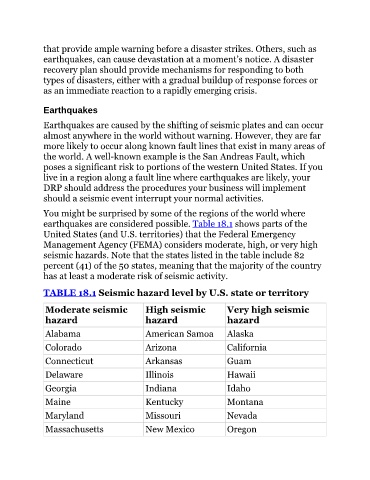
               earthquakes are considered possible. Table 18.1 shows parts of the

               United States (and U.S. territories) that the Federal Emergency
               Management Agency (FEMA) considers moderate, high, or very high
               seismic hazards. Note that the states listed in the table include 82
               percent (41) of the 50 states, meaning that the majority of the country
               has at least a moderate risk of seismic activity.


               TABLE 18.1 Seismic hazard level by U.S. state or territory

                Moderate seismic                 High seismic               Very high seismic
                hazard                           hazard                     hazard

                Alabama                          American Samoa             Alaska

                Colorado                         Arizona                    California

                Connecticut                      Arkansas                   Guam
                Delaware                         Illinois                   Hawaii

                Georgia                          Indiana                    Idaho

                Maine                            Kentucky                   Montana

                Maryland                         Missouri                   Nevada

                Massachusetts                    New Mexico                 Oregon

