


Page 1525 - (ISC)² CISSP Certified Information Systems Security Professional Official Study Guide
P. 1525
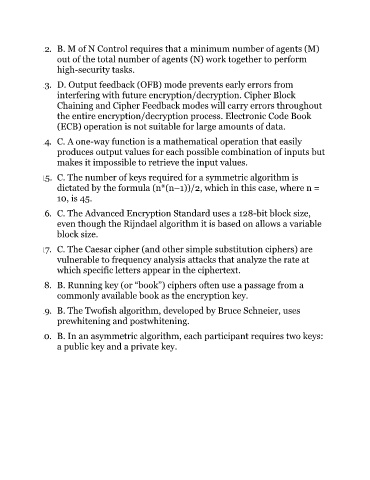
12.  B. M of N Control requires that a minimum number of agents (M)
                    out of the total number of agents (N) work together to perform

                    high-security tasks.

               13.  D. Output feedback (OFB) mode prevents early errors from
                    interfering with future encryption/decryption. Cipher Block
                    Chaining and Cipher Feedback modes will carry errors throughout
                    the entire encryption/decryption process. Electronic Code Book
                    (ECB) operation is not suitable for large amounts of data.

               14.  C. A one-way function is a mathematical operation that easily
                    produces output values for each possible combination of inputs but

                    makes it impossible to retrieve the input values.

               15.  C. The number of keys required for a symmetric algorithm is
                    dictated by the formula (n*(n–1))/2, which in this case, where n =
                    10, is 45.

               16.  C. The Advanced Encryption Standard uses a 128-bit block size,
                    even though the Rijndael algorithm it is based on allows a variable

                    block size.

               17.  C. The Caesar cipher (and other simple substitution ciphers) are
                    vulnerable to frequency analysis attacks that analyze the rate at
                    which specific letters appear in the ciphertext.

              18.  B. Running key (or “book”) ciphers often use a passage from a
                    commonly available book as the encryption key.

               19.  B. The Twofish algorithm, developed by Bruce Schneier, uses
                    prewhitening and postwhitening.

              20.  B. In an asymmetric algorithm, each participant requires two keys:

                    a public key and a private key.

