


Page 230 - (ISC)² CISSP Certified Information Systems Security Professional Official Study Guide
P. 230
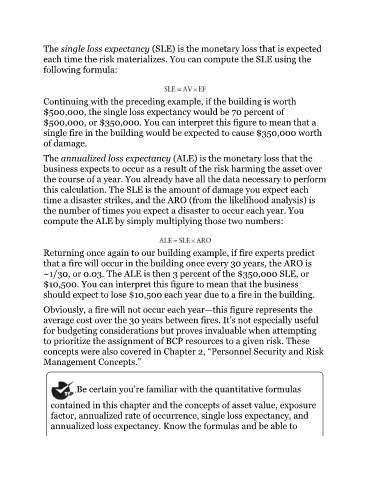
The single loss expectancy (SLE) is the monetary loss that is expected
               each time the risk materializes. You can compute the SLE using the

               following formula:


               Continuing with the preceding example, if the building is worth
               $500,000, the single loss expectancy would be 70 percent of
               $500,000, or $350,000. You can interpret this figure to mean that a

               single fire in the building would be expected to cause $350,000 worth
               of damage.

               The annualized loss expectancy (ALE) is the monetary loss that the
               business expects to occur as a result of the risk harming the asset over
               the course of a year. You already have all the data necessary to perform
               this calculation. The SLE is the amount of damage you expect each
               time a disaster strikes, and the ARO (from the likelihood analysis) is

               the number of times you expect a disaster to occur each year. You
               compute the ALE by simply multiplying those two numbers:


               Returning once again to our building example, if fire experts predict

               that a fire will occur in the building once every 30 years, the ARO is
               ~1/30, or 0.03. The ALE is then 3 percent of the $350,000 SLE, or
               $10,500. You can interpret this figure to mean that the business
               should expect to lose $10,500 each year due to a fire in the building.

               Obviously, a fire will not occur each year—this figure represents the
               average cost over the 30 years between fires. It’s not especially useful
               for budgeting considerations but proves invaluable when attempting

               to prioritize the assignment of BCP resources to a given risk. These
               concepts were also covered in Chapter 2, “Personnel Security and Risk
               Management Concepts.”


                          Be certain you’re familiar with the quantitative formulas

                  contained in this chapter and the concepts of asset value, exposure
                  factor, annualized rate of occurrence, single loss expectancy, and
                  annualized loss expectancy. Know the formulas and be able to

