


Page 777 - (ISC)² CISSP Certified Information Systems Security Professional Official Study Guide
P. 777
There are also country variations known as country codes. (See
               www.iana.org/domains/root/db/ for details on current TLDs and

               country codes.) Note that the seventh original TLD was int, for
               international, which was replaced by the two-letter country codes.

               The registered domain name must be officially registered with one of
               any number of approved domain registrars, such as Network Solutions
               or 1and1.com.

               The far-left section of an FQDN can be either a single hostname, such
               as www, ftp, and so on, or a multisectioned subdomain designation,
               such as server1.group3.bldg5 .mycompany.com.


               The total length of an FQDN can’t exceed 253 characters (including
               the dots). Any single section can’t exceed 63 characters. FQDNs can
               only contain letters, numbers, and hyphens.

               Every registered domain name has an assigned authoritative name
               server. The primary authoritative name server hosts the original zone
               file for the domain. Secondary authoritative name servers can be

               used to host read-only copies of the zone file. A zone file is the
               collection of resource records or details about the specific domain.
               There are dozens of possible resource records (see
               http://en.wikipedia.org/wiki/List_of_DNS_record_types); the most
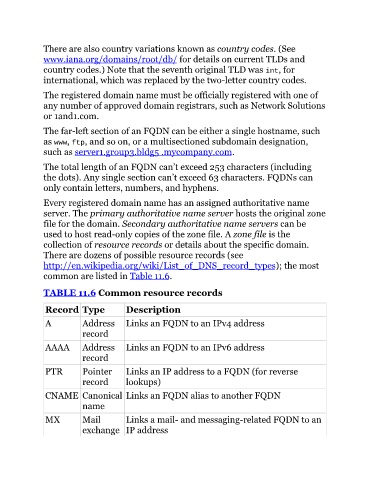
               common are listed in Table 11.6.


               TABLE 11.6 Common resource records

                Record Type                Description

                A           Address        Links an FQDN to an IPv4 address
                            record

                AAAA        Address        Links an FQDN to an IPv6 address
                            record

                PTR         Pointer        Links an IP address to a FQDN (for reverse
                            record         lookups)

                CNAME Canonical Links an FQDN alias to another FQDN
                            name

                MX          Mail           Links a mail- and messaging-related FQDN to an
                            exchange IP address

