


Page 824 - (ISC)² CISSP Certified Information Systems Security Professional Official Study Guide
P. 824
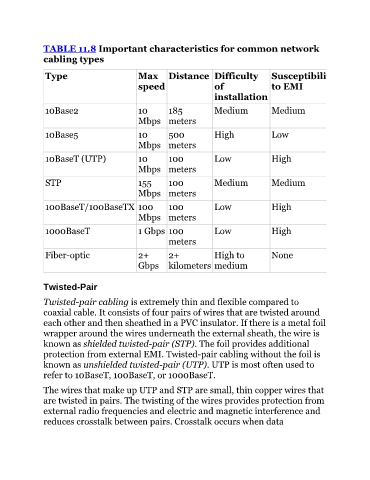
TABLE 11.8 Important characteristics for common network
               cabling types


                Type                           Max       Distance Difficulty               Susceptibility
                                               speed                    of                 to EMI
                                                                        installation

                10Base2                        10        185            Medium             Medium
                                               Mbps meters

                10Base5                        10        500            High               Low
                                               Mbps meters

                10BaseT (UTP)                  10        100            Low                High
                                               Mbps meters

                STP                            155       100            Medium             Medium
                                               Mbps meters

                100BaseT/100BaseTX 100                   100            Low                High
                                               Mbps meters

                1000BaseT                      1 Gbps 100               Low                High
                                                         meters

                Fiber-optic                    2+        2+             High to            None
                                               Gbps      kilometers medium


               Twisted-Pair


               Twisted-pair cabling is extremely thin and flexible compared to
               coaxial cable. It consists of four pairs of wires that are twisted around
               each other and then sheathed in a PVC insulator. If there is a metal foil
               wrapper around the wires underneath the external sheath, the wire is
               known as shielded twisted-pair (STP). The foil provides additional
               protection from external EMI. Twisted-pair cabling without the foil is
               known as unshielded twisted-pair (UTP). UTP is most often used to

               refer to 10BaseT, 100BaseT, or 1000BaseT.

               The wires that make up UTP and STP are small, thin copper wires that
               are twisted in pairs. The twisting of the wires provides protection from
               external radio frequencies and electric and magnetic interference and
               reduces crosstalk between pairs. Crosstalk occurs when data

