


Page 895 - (ISC)² CISSP Certified Information Systems Security Professional Official Study Guide
P. 895
consists of the security elements of IPv6 crafted into an add-on
               package for IPv4. IPsec works only on IP networks and provides for

               secured authentication as well as encrypted data transmission. IPsec
               has two primary components, or functions:

               Authentication Header (AH) AH provides authentication,
               integrity, and nonrepudiation.

               Encapsulating Security Payload (ESP) ESP provides
               encryption to protect the confidentiality of transmitted data, but it can
               also perform limited authentication. It operates at the Network layer
               (layer 3) and can be used in transport mode or tunnel mode. In

               transport mode, the IP packet data is encrypted but the header of the
               packet is not. In tunnel mode, the entire IP packet is encrypted and a
               new header is added to the packet to govern transmission through the
               tunnel.

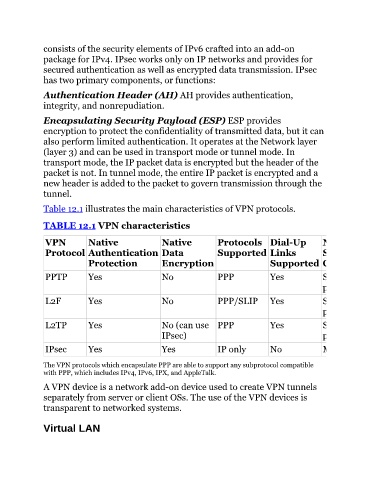
               Table 12.1 illustrates the main characteristics of VPN protocols.


               TABLE 12.1 VPN characteristics

                VPN           Native                   Native            Protocols Dial-Up                  Number of
                Protocol Authentication Data                             Supported Links                    Simultaneous

                              Protection               Encryption                         Supported Connections
                PPTP          Yes                      No                PPP              Yes               Single point-to-
                                                                                                            point

                L2F           Yes                      No                PPP/SLIP         Yes               Single point-to-

                                                                                                            point
                L2TP          Yes                      No (can use PPP                    Yes               Single point-to-
                                                       IPsec)                                               point

                IPsec         Yes                      Yes               IP only          No                Multiple


               The VPN protocols which encapsulate PPP are able to support any subprotocol compatible
               with PPP, which includes IPv4, IPv6, IPX, and AppleTalk.

               A VPN device is a network add-on device used to create VPN tunnels
               separately from server or client OSs. The use of the VPN devices is
               transparent to networked systems.


               Virtual LAN

