


Page 333 - Arte e Historia
P. 333
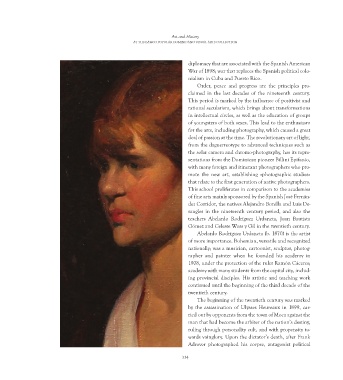
Art and History

at the Banco popular dominicano visual arts collection

                              diplomacy that are associated with the Spanish American
                              War of 1898; war that replaces the Spanish political colo-
                              nialism in Cuba and Puerto Rico.

                                   Order, peace and progress are the principles pro-
                              claimed in the last decades of the nineteenth century.
                              This period is marked by the influence of positivist and
                              rational secularism, which brings about transformations
                              in intellectual circles, as well as the education of groups
                              of youngsters of both sexes. This lead to the enthusiasm
                              for the arts, including photography, which caused a great
                              deal of passion at the time. The revolutionary art of light,
                              from the daguerreotype to advanced techniques such as
                              the solar camera and chromo-photography, has its repre-
                              sentations from the Dominican pioneer Billini Epifanio,
                              with many foreign and itinerant photographers who pro-
                              mote the new art, establishing «photographic studies»
                              that relate to the first generation of native photographers.
                              This school proliferates in comparison to the academies
                              of fine arts mainly sponsored by the Spanish José Fernán-
                              dez Corridor, the natives Alejandro Bonilla and Luis De-
                              sangles in the nineteenth century period, and also the
                              teachers Abelardo Rodríguez Urdaneta, Juan Bautista
                              Gómez and Celeste Woss y Gil in the twentieth century.

                                   Abelardo Rodríguez Urdaneta (b. 1870) is the artist
                              of more importance. Bohemian, versatile and recognized
                              nationally; was a musician, cartoonist, sculptor, photog-
                              rapher and painter when he founded his academy in
                              1908, under the protection of the ruler Ramón Cáceres;
                              academy with many students from the capital city, includ-
                              ing provincial disciples. His artistic and teaching work
                              continued until the beginning of the third decade of the
                              twentieth century.

                                   The beginning of the twentieth century was marked
                              by the assassination of Ulysses Heureaux in 1899, car-
                              ried out by opponents from the town of Moca against the
                              man that had become the arbiter of the nation’s destiny,
                              ruling through personality cult, and with propensity to-
                              wards vainglory. Upon the dictator’s death, after Frank
                              Adrover photographed his corpse, antagonist political

                                334

