


Page 372 - Arte e Historia
P. 372
Danilo De los Santos

canvas, ointments and glue applying, hair treatment (…) Great      26x36 inch., 1974 v «Composition,» oil/canvas, 24x20 inch.,
treatment, great drawing, better composition and excellent ex-
pression (…) put us face to face to the men loneliness and the     1975 v «Wagon, Sugarcane Time,» oil/canvas, 35x25 inch.,
death». (El Caribe, Sept. 13th, 1975). «Cloistered» mix/
canvas, 20.5x20.5 inch., 1976. Related to anguish and lone-        1976 v «My Land’s Sun,» acrylic/canvas, 35x47 inch., 1977 v
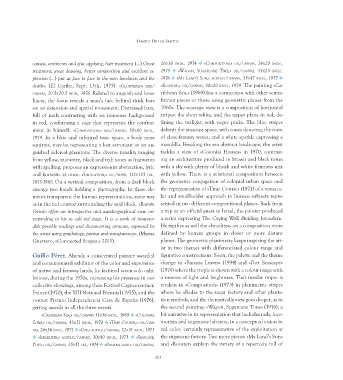
liness, the focus reveals a man’s face behind thick bars           «Rooster,» oil/canvas, 30x20 inch., 1979. The painting «Ca-
on an extension and spatial movement. Distressed bars,             ribbean Sea,» (1969) has a connection with other semia-
full of nails contrasting with an immense background               bstract pieces or those using geometric planes from the
in red, conforming a cage that represents the confine-             1960s. The seascape view is a composition of horizontal
ment in himself. «Composition,» mix/canvas, 50x60 inch.,           stripes: the short white, and the upper plane in red, de-
1979. In a blue and informal tone space, a body mass               fining the twilight, with vague pinks. The blue stripes
squirms, may be representing a lost astronaut or an an-            delimit the seascape space, with tones denoting the train
guished sidereal phantom. The diverse tonality ranging             of close-faraway waves, and a white sparkle expressing a
from yellow, mammee, black and red: tones as fragments             marolilla. Breaking the sea abstract landscape, the artist
with spelling, proposes an expressionist abstraction, lyric        tackles a view of «Colonial Houses» in 1970, contrast-
and fantastic at once. «Simulation,» oil/paper, 112x125 cm.,       ing an architecture produced in brown and black tones
1975-1980. On a vertical composition, from a dark block            with a sky with plenty of bluish and white firmness mix
emerge two hands holding a photography. In these ele-              with yellow. There is a relational composition between
ments transparent the human representations, same way              the geometric conjugation of colonial urban space and
as in the red context surrounding the said block. «Ramón           the representation of «Time Course» (1971) of a vernacu-
Oviedo offers an introspective and autobiographical view cor-      lar and smallholder approach to human subjects repre-
responding to his so call red stage. It is a work of innumer-      sented in two different compositional planes. Back from
able possible readings and disconcerting contents, expressed by    a trip as an official guest in Israel, the painter produced
the artist using graphology, patina and transparency». (Myrna      a series expressing The Crying Wall dividing Jerusalem.
Guerrero, «Connected Scopes,» 2011).                               He typifies as well the «Israelites» on a composition more
                                                                   defined by human groups in closer or more distant
Guillo Pérez. Already a consecrated painter awarded                planes. The geometric planimetry keeps inspiring the art-
                                                                   ist in two themes with differentiated colour range and
and consummated exhibitor of the color and experience              figurative constructions. Soon, the palette and the theme
of native and faraway lands, he featured seven solo exhi-          change in «Banana Leaves» (1994) and «Port Seascape»
bitions, during the 1970s, increasing his presence in our          (1974) where the tropic is shown with a colour range with
collective showings, among then Festival Cagnes-ser-mer,           a nuance of light and brightness. That insular tropic is
France (1970), the XIII National Biennial (1975), and the          retaken in «Composition» (1973) in planimetric stripes
contest Premio Independencia Casa de España (1976),                where he alludes to the sugar factory and other planta-
getting awards in all the three events.                            tion symbols, and the thematically view goes deeper, as in
                                                                   the second painting: «Wagon, Sugarcane Time» (1976), a
     «Caribbean Sea,» oil/canvas 31x36 inch., 1969 v «Colonial     bit narrative in its representation that includes rails, loco-
                                                                   motives and sugarcane laborers, in a conceptual vision in
Zone,» oil/canvas, 43x51 inch., 1970 v «Time Course,» oil/can-     red color, certainly representative of the exploitation at
                                                                   the sugarcane factory. Two more pieces: «My Land’s Sun»
vas, 26x36 inch., 1971 v «Cry,» acrylic/canvas, 32x51 inch., 1973  and «Rooster» explain the variety of a repertoire full of

v «Israelites,» acrylic/canvas, 30x40 inch., 1973 v «Seascape,

Port,» oil/canvas, 35x51 cm., 1974 v «Banana leaf,» oil/canvas,

                                                                   373

