


Page 418 - Arte e Historia
P. 418
Danilo De los Santos

    5. A RETURN TO THE CRITICAL CHRO-                            from that source all poetic and formal resources that are neces-
    NOLOGY since the early twentieth century to the              sary in the definition of a personal visual universe, one of the
    end of that decade allows us to focus on young artists       most amazing ones that contemporary Dominican painting can
    of the generation of 1990, which we call «novecentis-        count on.» (Amable López Meléndez).
    tas». Yolanda Monción (Yuli), Mario José Ángeles,
    Dinorah Álvarez and Mariano Sánchez, are artists                 The upheaval, the uncertainty of the form, the painful scream
    who graduated from   training centres, and their             of the lacerated matter, indicate the aesthetic ritual that frames
    works and names are recorded in individual or group          anti-forms in Mariano Sánchez’s painting. (Arnulfo Soto).
    exhibitions, as an important projection into the new
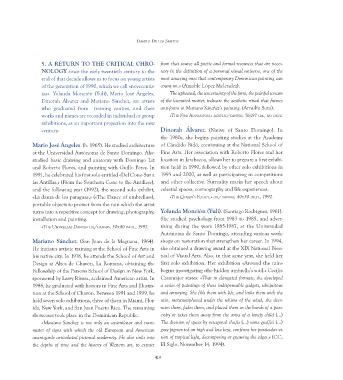
    century.                                                          «The Fire Adoration,» acrylic/canvas, 76x97 cm., no date.

Mario José Ángeles. (b. 1965). He studied architecture           Dinorah Álvarez. (Native of Santo Domingo). In

at the Universidad Autónoma de Santo Domingo. Also               the 1980s, she begins painting studies at the Academy
studied basic drawing and anatomy with Domingo Liz               of Cándido Bidó, continuing at the National School of
and Roberto Flores, and painting with Guillo Pérez. In           Fine Arts. Her association with Roberto Flores and her
1991, he celebrated his first solo entitled «Del Cono Sur a      location in Jarabacoa, allows her to prepare a first exhibi-
las Antillas,» (From the Southern Cone to the Antilles»),        tion held in 1990, followed by other solo exhibitions in
and the following year (1992), the second solo exhibit,          1995 and 2000, as well as participating in competitions
«La danza de los paraguas,» («The Dance of umbrellas»),          and other collective. Surreality marks her speech about
portable objects to protect from the rain which the artist       celestial spaces, cosmography and life experiences.
turns into a repetitive concept for drawing, photography,
installation and painting.                                            «The Queen’s Flight,» oil/canvas, 40x50 inch., 1992.

     «The Umbrellas Dance» oil/canvas, 30x40 inch., 1997.        Yolanda Monción (Yuli). (Santiago Rodríguez, 1961).

Mariano Sánchez. (San Juan de la Maguana, 1964).                 She studied psychology from 1983 to 1985, and adver-
                                                                 tising during the years 1985-1987, at the Universidad
He initiates artistic training at the School of Fine Arts in     Autónoma de Santo Domingo, attending various work-
his native city. In 1918, he attends the School of Art and       shops on restoration that strengthen her career. In 1994,
Design at Altos de Chavón, La Romana, obtaining the              she obtained a drawing award at the XIX National Bien-
Fellowship of the Parsons School of Design in New York,          nial of Visual Arts. Also, in that same year, she held her
sponsored by Larry Rivera, acclaimed American artist. In         first solo exhibition. Her exhibition «Around the rain»
1988, he graduated with honors in Fine Arts and Illustra-        begins investigating «the hidden umbrella’s soul.» Cecilia
tion at the School of Chavón. Between 1991 and 1999, he          Casamajor states: «That in elongated formats, she developed
held seven solo exhibitions, three of them in Miami, Flor-       a series of paintings of these indispensable gadgets, ubiquitous
ida, New York, and San Juan Puerto Rico. The remaining           and annoying. She fills them with life, and links them with the
showcases took place in the Dominican Republic.                  rain, metamorphosed under the whims of the wind, she deco-
                                                                 rates them, fades them, and placed them in the hands of a pass-
    «Mariano Sánchez is not only an assimilator and trans-       ersby or takes them away from the arms of a lonely child (…)
muter of signs with which the old European and American          The division of space by octagonal shafts (…) some graffiti (…)
avant-garde articulated pictorial modernity. He also sinks into  gray pigmented on high and low keys, confirms her particular vi-
the depths of time and the history of Western art, to extract    sion of tropical light, decomposing or gnawing the edges.» (CC,
                                                                 El Siglo, November 14, 1994).

                                                                 419

