


Page 14 - sarah-simblet_sketch-book-for-the-artist
P. 14
14

INTRODUCTION  ALCHEMY

              At school, and sometimes beyond, we are advised or even        energy and focus of the moment to be expressed through
              required to plan our pictures, declare the idea, explain the   controlled accident and a degree of the unknown Both

              composition, and practice each part before putting the final   drawings were made trusting the marks, and at speeds

              image together. This suits many artists well and is perfectly  beyond conscious thought.

              valid. However, excessive planning can get in the              As you draw any subject—something you see, feel, or

              way of the imagination, the unknown, and what                  imagine—it is not enough to only render its shape,

              you discover in the process of making. It denies               size, and position in space. You must also think of its

              the importance of accident, which can offer                    intrinsic nature: its purpose, meaning, and how it feels

              keys to other things.                                          to the touch. Know the texture, temperature,

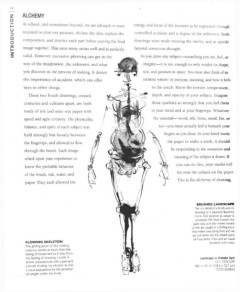
                 These two brush drawings, created                           depth, and opacity of your subject. Imagine
              centuries and cultures apart, are both                         these qualities so strongly that you feel them
              made of ink laid onto wet paper with                           in your mind and at your fingertips. Whatever
              speed and agile certainty. The physicality,                     the material— wood, silk, bone, metal, fire, or
              balance, and spirit of each subject was
              held strongly but loosely between                                    ice—you must actually feel it beneath your
              the fingertips, and allowed to flow                                       fingers as you draw. As your hand meets
              through the brush. Each image                                                the paper to make a mark, it should
              relied upon past experience to                                                 be responding to the sensation and
              know the probable behavior                                                        meaning of the subject it draws. If
              of the brush, ink, water, and                                                       you can do this, your marks will
              paper. They each allowed the                                                         become the subject on the paper.
                                                                                                   This is the alchemy of drawing.

              FLOWING SKELETON                                                                              BRUSHED LANDSCAPE
              The gliding poise of this walking                                                           This is a detail of a brush-and-ink
              anatomy comes as much from the                                                               drawing by a Japanese Buddhist
              feeling of movement as it does from                                                          monk. Our position asvieweris
              the feeling of drawing. I made it                                                             unsteady. W e float toward the
              almost unconsciously with a pen and                                                        quiet vista as it also moves toward
              a brush, trusting my intuition to find                                                    us. We are caught in a shifting focus
              a visual equivalence for the sensation                                                    that makes everything fluid, and we
              of weight within my body.                                                                 can just make out the distant stains
                                                                                                         of mountains, mists, and an island

                                                                                                                           brushed with trees.

                                                                                                                 Landscape in Haboku Style
                                                                                                                                     15TH CENTURY

