


Page 42 - Vol 7 No 3 July September 2017
P. 42
PESY: Print ISSN 2231-1394, Online ISSN 2278-795X                       Vol.7 No.3


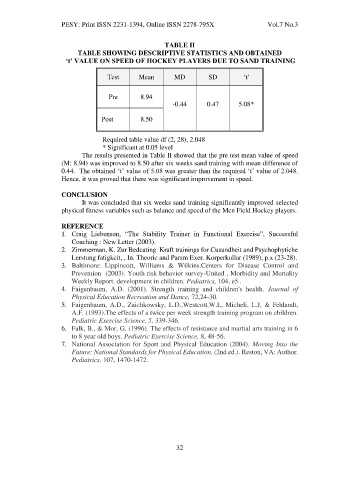
                                                           TABLE II
                            TABLE SHOWING DESCRIPTIVE STATISTICS AND OBTAINED
                         ‘t’ VALUE ON SPEED OF HOCKEY PLAYERS DUE TO SAND TRAINING

                                       Test       Mean        MD          SD           ‘t'


                                       Pre        8.94        -0.44       0.47       5.08*

                                     Post         8.50


                                     Required table value df (2, 28), 2.048
                                     * Significant at 0.05 level
                              The results presented in Table II showed that the pre test mean value of speed
                       (M: 8.94) was improved to 8.50 after six weeks sand training with mean difference of
                       0.44.  The obtained ‘t’ value of 5.08 was greater than the required ‘t’ value of 2.048.
                       Hence, it was proved that there was significant improvement in speed.

                       CONCLUSION
                              It was concluded that six weeks sand training significantly improved selected
                       physical fitness variables such as balance and speed of the Men Field Hockey players.

                       REFERENCE
                       1.  Craig  Liebenson,  “The  Stability  Trainer  in  Functional  Exercise”,  Successful
                          Coaching : New Letter (2003).
                       2.  Zimmerman, K. Zur Bedcating  Kraft trainings for Cusundheit and Psychophytiche
                          Lerstung fatigkcit, , In. Theoric and Parsm Exer. Korperkullar (1989), p.x (23-28).
                       3.  Baltimore:  Lippincott,  Williams  &  Wilkins.Centers  for  Disease  Control  and
                          Prevention  (2003). Youth risk behavior survey-United , Morbidity and Mortality
                          Weekly Report. development in children. Pediatrics, 104, e5 .
                       4.  Faigenbaum,  A.D.  (2001).  Strength  training  and  children's  health.  Journal  of
                          Physical Education Recreation and Dance, 72,24-30.
                       5.  Faigenbaum,  A.D., Zaichkowsky,  L.D.,Westcott,W.L, Micheli,  L.J,  &  Fehlandt,
                          A.F. (1993).The effects of a twice per week strength training program on children.
                          Pediatric Exercise Science, 5, 339-346.
                       6.  Falk, B., & Mor, G. (1996). The effects of resistance and martial arts training in 6
                          to 8 year old boys. Pediatric Exercise Science, 8, 48-56.
                       7.  National Association  for Sport and Physical Education (2004).  Moving  Into the
                          Future: National Standards for Physical Education. (2nd ed.). Reston, VA: Author.
                          Pediatrics, 107, 1470-1472.


                                                               32

