


Page 149 - The Iron Games E-book
P. 149
The Iron Games                           Weightlifting


                       The first male world champion was crowned in
               1891.  Women's  competition  did  not  exist,  and  the
               weightlifters were not categorized by height or weight.
                       The    first   Olympic
               Games     of   1896   included
               weightlifting in the Field event
               of  the  predecessor  to  today's
               Track  and  Field  or  Athletics
               event.
                       During     the    1900
               Olympic  Games,  there  was  no
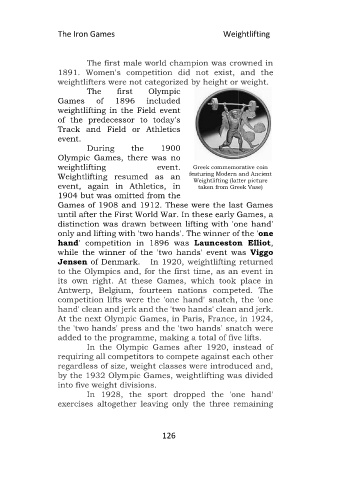
               weightlifting            event.   Greek commemorative coin
               Weightlifting  resumed  as  an   featuring Modern and Ancient
                                                 Weightlifting (latter picture
               event,  again  in  Athletics,  in   taken from Greek Vase)
               1904 but was omitted from the
               Games of 1908 and 1912. These were the last Games
               until after the First World War. In these early Games, a
               distinction was drawn between lifting with 'one hand'
               only and lifting with 'two hands'. The winner of the 'one
               hand'  competition  in  1896  was  Launceston  Elliot,
               while  the  winner  of  the  'two  hands'  event  was  Viggo
               Jensen of Denmark.   In 1920, weightlifting returned
               to the Olympics and, for the first time, as an event in
               its  own  right.  At  these  Games,  which  took  place  in
               Antwerp,  Belgium,  fourteen  nations  competed.  The
               competition lifts were the 'one hand' snatch, the 'one
               hand' clean and jerk and the 'two hands' clean and jerk.
               At the next Olympic Games, in Paris, France, in 1924,
               the 'two hands' press and the 'two hands' snatch were
               added to the programme, making a total of five lifts.
                       In  the  Olympic  Games  after  1920,  instead  of
               requiring all competitors to compete against each other
               regardless of size, weight classes were introduced and,
               by the 1932 Olympic Games, weightlifting was divided
               into five weight divisions.
                       In  1928,  the  sport  dropped  the  'one  hand'
               exercises  altogether  leaving  only  the  three  remaining


                                         126

