


Page 106 - October 2018 converted
P. 106
bursting into flames whenever things spiral out of control, with a little nudge
                                                                  from the sisters. And there’s nothing that their loving father Bapu (Raaz) nor the
                                                                  respective men in their lives (Duhan and Das) can do which will change things.
                                                                  This is a wonderful ensemble cast. The village rich guy (Verma), festooned with
                                                                  gold chains, who lusts after the two feuding sisters; the Naarad Muni type ‘fami-
                                                                  ly friend’ called Dipper (Grover); the googly-eyed ‘vaid’, the wise old ‘daadi’; the
                                                                  two who play the lovers-cum-spouses of the two sisters; Raaz, pitch–perfect as
                                                                  the father, all work in tandem.
                                                                  Bharadwaj’s touch with names is in evidence here too. One of my all-time fa-

                                                                  vourites, Billo Chaman Bahaar, from Omkara, is almost trumped here by Dipper,
                   movie review                                   called thus because he has a lazy eye, which keeps ‘dipping’. And in the way

                                                                  Genda is called ‘Marigold’ by her besotted lover.
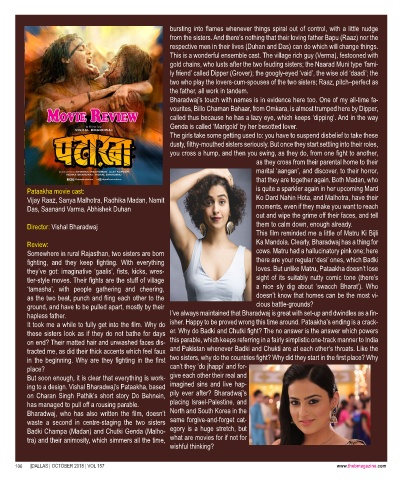
                                                                  The girls take some getting used to: you have to suspend disbelief to take these
                                                                  dusty, filthy-mouthed sisters seriously. But once they start settling into their roles,
                                                                  you cross a hump, and then you swing, as they do, from one fight to another,
                                                                                                   as they cross from their parental home to their

                                                                                                   marital ‘aangan’, and discover, to their horror,
                                                                                                   that they are together again. Both Madan, who
           Pataakha movie cast:                                                                    is quite a sparkler again in her upcoming Mard
           Vijay Raaz, Sanya Malhotra, Radhika Madan, Namit                                        Ko Dard Nahin Hota, and Malhotra, have their

           Das, Saanand Varma, Abhishek Duhan                                                      moments, even if they make you want to reach
                                                                                                   out and wipe the grime off their faces, and tell

           Director: Vishal Bharadwaj                                                              them to calm down, enough already.
                                                                                                   This film reminded me a little of Matru Ki Bijli

           Review:                                                                                 Ka Mandola. Clearly, Bharadwaj has a thing for
           Somewhere in rural Rajasthan, two sisters are born                                      cows. Matru had a hallucinatory pink one; here
           fighting,  and  they  keep  fighting.  With  everything                                 there are your regular ‘desi’ ones, which Badki

           they’ve got: imaginative ‘gaalis’, fists, kicks, wres-                                  loves. But unlike Matru, Pataakha doesn’t lose
           tler-style moves. Their fights are the stuff of village                                 sight of its suitably nutty comic tone (there’s
           ‘tamasha’,  with people  gathering  and cheering,                                       a nice sly dig about ‘swacch Bharat’). Who
           as the two beat, punch and fling each other to the                                      doesn’t know that homes can be the most vi-
           ground, and have to be pulled apart, mostly by their                                    cious battle-grounds?
           hapless father.                                        I’ve always maintained that Bharadwaj is great with set-up and dwindles as a fin-
           It took me a while to fully get into the film. Why do   isher. Happy to be proved wrong this time around. Pataakha’s ending is a crack-
           these sisters look as if they do not bathe for days    er. Why do Badki and Chutki fight? The no answer is the answer which powers
           on end? Their matted hair and unwashed faces dis-      this parable, which keeps referring in a fairly simplistic one-track manner to India

           tracted me, as did their thick accents which feel faux   and Pakistan whenever Badki and Chukti are at each other’s throats. Like the
           in the beginning. Why are they fighting in the first   two sisters, why do the countries fight? Why did they start in the first place? Why
           place?                                                 can’t they ‘do jhappi’ and for-
           But soon enough, it is clear that everything is work-  give each other their real and
           ing to a design. Vishal Bharadwaj’s Pataakha, based    imagined sins and live hap-
           on Charan Singh Pathik’s short story Do Behnein,       pily ever after? Bharadwaj’s
           has managed to pull off a rousing parable.             placing Israel-Palestine, and

           Bharadwaj,  who  has  also  written  the  film,  doesn’t   North and South Korea in the
           waste a  second in centre-staging the two  sisters     same forgive-and-forget cat-
           Badki Champa (Madan) and Chutki Genda (Malho-          egory is a huge stretch, but
           tra) and their animosity, which simmers all the time,   what are movies for if not for
                                                                  wishful thinking?


       106   |DALLAS | OCTOBER 2018 | VOL 157                                                                                     www.thebmagazine.com

