


Page 4 - Newsletter1_2016
P. 4
EPTS UPDATES
                                                         EPTSCURRENT


                                                  NASA S’COOL
              Our M1 students are
        continuing to participate in the   and CloudSat Programs
        NASA S’COOL (Student Cloud
        Observation Online) Program.
        We had our fourth annual video
        conference with NASA scientist
        Dr. Lin Chambers on June 16th.
        Dr. Chambers explained the
        NASA Student Cloud Observation
        Project and the importance of
        our student observations. Our
        students make daily weather
        observations when satellites are
        over Bangkok and then upload
        their data to NASA. Our student
        observations are then combined
        with the satellite data to get a                                                   Physics     SAT
        complete picture of the weather.
        By participating in this project,                                                  Preparation
        our students can use their                                                         Classes Continue
        academic and scientific skills
        while engaging in a significant                                                    After enjoying a successful
        international research project.                                                    first year of the Physics SAT
        For more information, please                                                       preparation classes, students in
        see: http://science-edu.larc.nasa.                                                 M5 are ready to return and join
        gov/SCOOL/                                                                         their juniors in relaxed tutorial
              EPTS students also participate                                               sessions to help themselves get
        in another NASA project, the                                                       experience for the American
        CloudSat Program. CloudSat is                                                      test, which is used for university
        an experimental satellite that   the CloudSat website and NASA   Outreach Coordinator with   entrance, course placement,
        uses radar to observe clouds and   scientists then compare these   NASA’s Jet Propulsion Laboratory   and advanced college credit
        precipitation from space.  As with   ground observations with the data  in California.  Our students will   by a number of American
        the S’COOL program, students   they get back from the satellite.   have the opportunity to discuss   universities and a growing
        make observations from the   The overall aim of both the S’COOL  the CloudSat Program, as well as   number of Thai international
        ground at the same time that the   and Cloudsat projects is to improve  other projects it may be possible   university programs.  Meetings
        satellite passes overhead, but   the accuracy of remote-sensed   for EPTS students to get involved   are to be held as last year, on
        the CloudSAT observations are   data from satellites. This data can   in.          Thursday afternoons in the
        much more detailed and include   then be used to give scientists                   Curie Lab.  Students will be
        pictures of the cloud cover in   a better understanding of how   - A.Adam, EPTS Biology Teacher,   informed of the schedule very
        each of the four quadrants of   clouds, global weather patterns,   A.Craig, EPTS M1 & M3 Science   shortly.  Aj. David Nall looks
        the sky. They also take a picture   and climate change are linked.   Teacher       forward to sharing physics and
        of the whole sky by placing a   We have an additional Skype                        snacks with you!
        convex mirror on the ground   video conference planned for
        and photographing it. The   later this semester, this time                         -A. David Nall
        pictures and data are entered on   with Peter Falcon, Earth Science


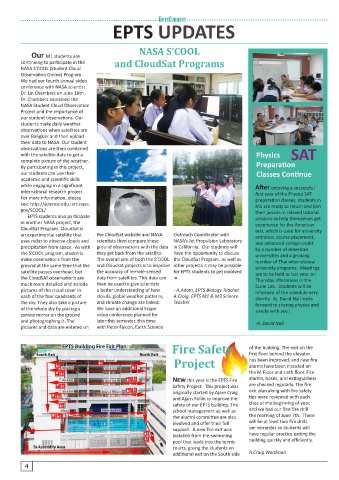
                                                             Fire Safety                of the building. The exit on the
                                                                                        first floor behind the elevator
                                                              Project                   has been improved, and new fire
                                                                                        alarms have been installed on
                                                                                        the M Floor and sixth floor. Fire
                                                              New this year is the EPTS Fire   alarms, hoses, and extinguishers
                                                              Safety Project.  This project was   are checked regularly. The fire
                                                              originally started by Ajarn Craig   exit plan along with fire safety
                                                              and Ajarn Rollin to improve the   tips were reviewed with each
                                                              safety of our EPTS building. The   class at the beginning of year,
                                                              school management as well as   and we had our first fire drill
                                                              the alumni committee are also   the morning of June 7th.  There
                                                              involved and offer their full   will be at least two fire drills
                                                              support.  A new fire exit was   per semester so students will
                                                              installed from the swimming   have regular practice exiting the
                                                              pool that leads into the tennis   building quickly and efficiently.
                                                              courts, giving the students an
                                                              additional exit on the South side   A.Craig Wardman
          4

