


Page 6 - Newsletter1_2017
P. 6
EPTS UPDATES
                                                        EPTSCURRENT


                                                                                     Mathematical

                                                                     modelling of infectious


                                                                             diseases workshop


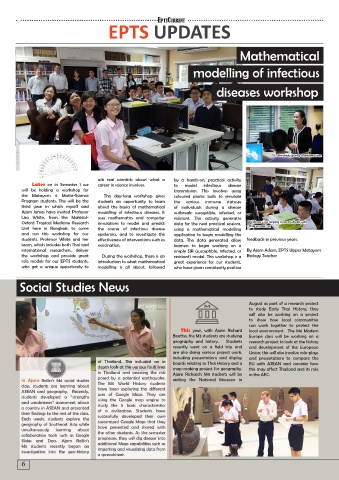
                                                                                                 Dr. Wirichida giving a presentation


                                   ask real scientists  about what a   by a hands-on, practical activity
             Later on in Semester  1 we   career in science involves.   to  model  infectious  disease
         will be holding  a workshop for                      transmission. This  involves using
         the  Matayom 6 Maths-Science     This  day-long  workshop  gives   coloured plastic balls to simulate
         Program students.  This will be the   students  an opportunity to learn   the  various  immune  statuses
         third year in which myself and   about the basics of mathematical   of individuals during a disease
         Ajarn James have invited Professor   modelling  of infectious diseases. It   outbreak: susceptible, infected,  or
         Lisa White,  from the Mahidol-  uses  mathematics and computer   resistant. This activity generates
         Oxford Tropical  Medicine Research   simulations to model and predict   data for the next practical sessions,   Professor Lisa helping some students with
                                                                                        their modelling
         Unit here  in Bangkok,  to  come   the  course  of infectious  disease   using  a mathematical modelling
         and  run this workshop  for  our   epidemics, and to investigate the   application to begin modelling the
         students.  Professor White and her   effectiveness of interventions such as   data.  The data  generated allow   feedback in previous years.
         team, which includes both Thai and   vaccination.    learners to begin working on a
         international researchers,  deliver                  simple SIR (susceptible, infected, or   By Ajarn Adam, EPTS Upper Matayom
         the workshop and provide great      During the workshop, there is an   resistant) model. This workshop is a   Biology Teacher
         role models for our EPTS students,   introduction to what mathematical   great experience for our students,
         who get a unique opportunity to   modelling is  all about,  followed   who have given consistently positive

        Social Studies News


                                                                                        August as part of a research project
                                                                                        to study Early Thai History; they

                                                                                        will  also  be working on a project
                                                                                        to show how local communities
                                                                                        can work together  to protect  the
                                                                 This year, with Ajarn  Richard   local environment.  The M6 Modern
                                                              Beattie, the M3 students are studying   Europe class  will be working on a
                                                              geography  and history.   Students   research project to look at the history
                                                              recently  went  on  a  field  trip  and   and  development of the European
                                                              are also doing various project work,   Union; this will also involve role-plays
                                                              including presentations and display   and presentations to compare the
                                   of Thailand.  This included an in   boards relating to Thai History and a   EU with  ASEAN  and consider how
                                   depth look at the various fault lines   map-making project for geography.    this may affect Thailand and its role
                                   in Thailand and assessing  the  risk   Ajarn  Richard’s  M4 students  will  be   in the AEC.
                                   posed by a potential  earthquake.
         In Ajarn Rollin’s  M4 social  studies                visiting the  National Museum  in
         class, students  are learning about   The M6 World History  students
                                   have been exploring  the different
         ASEAN and geography.  Recently,   uses  of Google Maps. They are
         students  developed a “strengths
         and weaknesses”  assessment  about   using the Google map engine to
                                   study  the  6 basic characteristics
         a country in ASEAN and presented
         their findings to the rest of the class.    of a civilization. Students  have
                                   successfully  developed their own
         Each week, students  explore the   customized Google Maps that they
         geography of Southeast Asia while
         simultaneously  learning  about  have presented  and shared with
                                   the other students. As the semester
         collaboration  tools such  as Google
         Slides and Docs. Ajarn Rollin’s   progresses, they will dig deeper into
                                   additional Maps capabilities such as
         M5 students  recently  began an   importing and visualizing data from
         investigation into the geo-history
                                   a spreadsheet.
         6

