


Page 40 - REPOWER REFERENCE GUIDE (2020)
P. 40
Engine Failure Diagnosis


                                                                              23036


                a                   b                   c                   d


                                                                                            23038
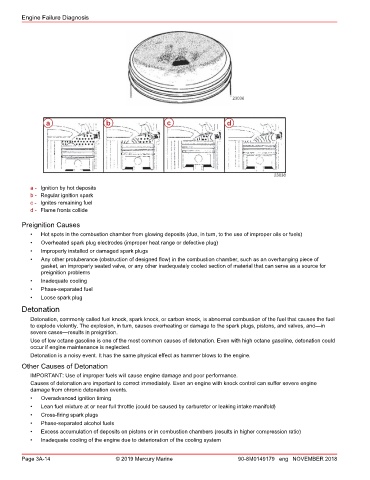
           a - Ignition by hot deposits
           b - Regular ignition spark
           c - Ignites remaining fuel
           d - Flame fronts collide

        Preignition Causes

           •   Hot spots in the combustion chamber from glowing deposits (due, in turn, to the use of improper oils or fuels)
           •   Overheated spark plug electrodes (improper heat range or defective plug)
           •   Improperly installed or damaged spark plugs
           •   Any other protuberance (obstruction of designed flow) in the combustion chamber, such as an overhanging piece of
               gasket, an improperly seated valve, or any other inadequately cooled section of material that can serve as a source for
               preignition problems
           •   Inadequate cooling
           •   Phase‑separated fuel
           •   Loose spark plug

        Detonation
           Detonation, commonly called fuel knock, spark knock, or carbon knock, is abnormal combustion of the fuel that causes the fuel
           to explode violently. The explosion, in turn, causes overheating or damage to the spark plugs, pistons, and valves, and—in
           severe cases—results in preignition.
           Use of low octane gasoline is one of the most common causes of detonation. Even with high octane gasoline, detonation could
           occur if engine maintenance is neglected.
           Detonation is a noisy event. It has the same physical effect as hammer blows to the engine.
        Other Causes of Detonation

           IMPORTANT: Use of improper fuels will cause engine damage and poor performance.
           Causes of detonation are important to correct immediately. Even an engine with knock control can suffer severe engine
           damage from chronic detonation events.
           •   Overadvanced ignition timing
           •   Lean fuel mixture at or near full throttle (could be caused by carburetor or leaking intake manifold)
           •   Cross‑firing spark plugs
           •   Phase‑separated alcohol fuels
           •   Excess accumulation of deposits on pistons or in combustion chambers (results in higher compression ratio)
           •   Inadequate cooling of the engine due to deterioration of the cooling system


        Page 3A-14                     © 2019 Mercury Marine                    90-8M0149179 eng NOVEMBER 2018

