


Page 25 - Science Class 6 Times Publication
P. 25
Force
We do various types of works in our daily life. We open door, lift load,
carry books, push carts, etc. In order to do all these works, we have
to apply force. Similarly, we need force to stop a moving object. We
apply force by pushing or pulling the objects. We push carts, or doors.
We pull water from well or pull doors, etc.
Force changes the state of bodies from rest to motion or from motion to
rest. When we apply force to an object at rest, it comes to motion state.
Similarly, when we apply force to a moving object, it comes to rest.
Thus, force can be dened as an external agent, which changes or
tries to change the state of body from rest to motion or motion to rest .
The SI unit of force is Newton and CGS unit is Dyne. In short, Newton
is denoted by N.
The force required to pull or push an object of mass 100 g is equal to 1
Newton. Similarly, the force required to pull or push 1 kg object is 10N.
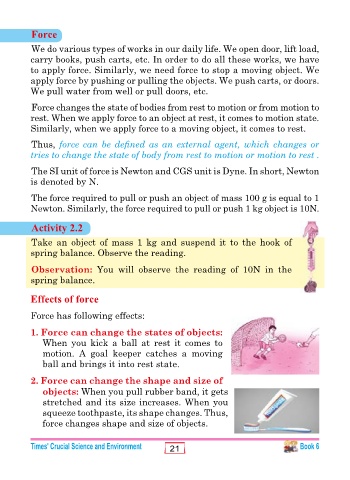
Activity 2.2
Take an object of mass 1 kg and suspend it to the hook of
spring balance. Observe the reading.
Observation: You will observe the reading of 10N in the
spring balance.
Effects of force
Force has following effects:
1. Force can change the states of objects:
When you kick a ball at rest it comes to
motion. A goal keeper catches a moving
ball and brings it into rest state.
2. Force can change the shape and size of
objects: When you pull rubber band, it gets
stretched and its size increases. When you
squeeze toothpaste, its shape changes. Thus,
force changes shape and size of objects.
Times' Crucial Science and Environment 21 Book 6

