


Page 94 - Science Class 6 Times Publication
P. 94
more mass and smaller object has less mass.
An object occupies space. It means an object needs space to exist. The
total space occupied by an object is called its volume. Bigger objects
have more volume and smaller objects have less volume.
Activity 9.1
To show that air occupies space
Materials required: An empty bottle, a bucket of water
Procedure
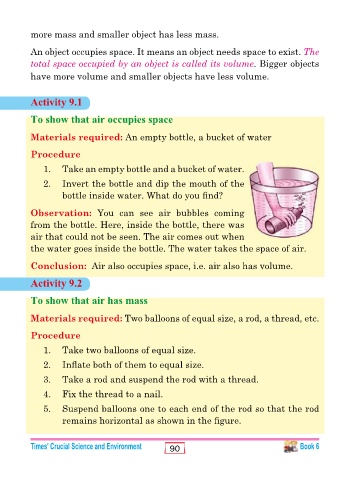
1. Take an empty bottle and a bucket of water.
2. Invert the bottle and dip the mouth of the
bottle inside water. What do you nd?
Observation: You can see air bubbles coming
from the bottle. Here, inside the bottle, there was
air that could not be seen. The air comes out when
the water goes inside the bottle. The water takes the space of air.
Conclusion: Air also occupies space, i.e. air also has volume.
Activity 9.2
To show that air has mass
Materials required: Two balloons of equal size, a rod, a thread, etc.
Procedure
1. Take two balloons of equal size.
2. Inate both of them to equal size.
3. Take a rod and suspend the rod with a thread.
4. Fix the thread to a nail.
5. Suspend balloons one to each end of the rod so that the rod
remains horizontal as shown in the gure.
Times' Crucial Science and Environment 90 Book 6

