


Page 24 - RUSSIA (10)
P. 24
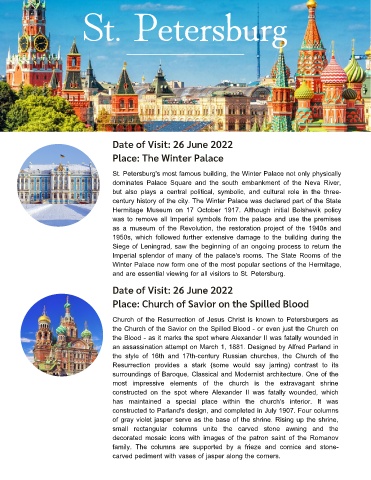
St. Petersburg


                                      Date of Visit: 26 June 2022

                                      Place: The Winter Palace


                                      St. Petersburg's most famous building, the Winter Palace not only physically
                                      dominates  Palace  Square  and  the  south  embankment  of  the  Neva  River,
                                      but  also  plays  a  central  political,  symbolic,  and  cultural  role  in  the  three-
                                      century history of the city. The Winter Palace was declared part of the State
                                      Hermitage  Museum  on  17  October  1917.  Although  initial  Bolshevik  policy
                                      was to remove all Imperial symbols from the palace and use the premises
                                      as  a  museum  of  the  Revolution,  the  restoration  project  of  the  1940s  and
                                      1950s, which followed further extensive damage to the building during the
                                      Siege of Leningrad, saw the beginning of an ongoing process to return the
                                      Imperial splendor of many of the palace's rooms. The State Rooms of the
                                      Winter Palace now form one of the most popular sections of the Hermitage,
                                      and are essential viewing for all visitors to St. Petersburg.
                                      Date of Visit: 26 June 2022

                                      Place: Church of Savior on the Spilled Blood


                                      Church of the Resurrection of Jesus Christ is known to Petersburgers as
                                      the Church of the Savior on the Spilled Blood - or even just the Church on
                                      the Blood - as it marks the spot where Alexander II was fatally wounded in
                                      an assassination attempt on March 1, 1881. Designed by Alfred Parland in
                                      the  style  of  16th  and  17th-century  Russian  churches,  the  Church  of  the
                                      Resurrection  provides  a  stark  (some  would  say  jarring)  contrast  to  its
                                      surroundings of Baroque, Classical and Modernist architecture. One of the
                                      most  impressive  elements  of  the  church  is  the  extravagant  shrine
                                      constructed  on  the  spot  where  Alexander  II  was  fatally  wounded,  which
                                      has  maintained  a  special  place  within  the  church's  interior.  It  was
                                      constructed to Parland's design, and completed in July 1907. Four columns
                                      of gray violet jasper serve as the base of the shrine. Rising up the shrine,
                                      small  rectangular  columns  unite  the  carved  stone  awning  and  the
                                      decorated mosaic icons with images of the patron saint of the Romanov
                                      family.  The  columns  are  supported  by  a  frieze  and  cornice  and  stone-
                                      carved pediment with vases of jasper along the corners.

