


Page 10 - Math Smart - 7
P. 10
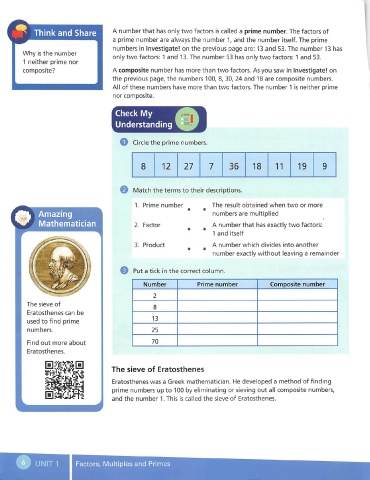
A number that has only two factors is called a prime number. The factors of
                                     a prime number are always the number 1, and the number itself. The prime
                                      numbers in Investigate! on the previous page are: 13 and 53. The number 13 has
        why is the number
                                     only two factors: 1 and 13. The number 53 has only two factors: 1 and 53.
        1 neither prime nor
        composite?                    A composite number has more than two factors. As you saw in Investigate! on
                                     the previous page, the numbers 100, 8, 30, 24 and 18 are composite numbers.
                                      All of these numbers have more than two factors. The number 1 is neither prime
                                      nor composite.

                                      Check My

                                       Understanding

                                        O Circle the prime numbers.


                                              8      12      27      7     36      18     11     19      9


                                        Q Match the terms to their descriptions.

                                             1. Prime number          The result obtained when two or more
             Amazing                                                  numbers are multiplied
              Mathematician                  2. Factor                A number that has exactly two factors:
                                                                      1 and itself

                                             3. Product               A number which divides into another
                                                                      number exactly without leaving a remainder

                                        @ Put a tick in the correct column.

                                                Number           Prime number            Composite number

                                                   2
          The sieve of
                                                   8
          Eratosthenes can be
                                                  13
          used to find prime
          numbers.                                25
          Find out more about                     70
          Eratosthenes.

               SMH
                                     The sieve of Eratosthenes
                                     Eratosthenes was a Greek mathematician. He developed a method of finding
                                     prime numbers up to 100 by eliminating or sieving out all composite numbers,
                                     and the number 1. This is called the sieve of Eratosthenes.


                          Factors, Multiples and Primes

