


Page 125 - Math Smart - 7
P. 125
In this chapter
           CHAPTER 6.1
                                                                                         Pupils should be able to:
                                                                                        • identify, describe and

         Types of Angles                                                                    estimate the size of
                                                                                            angles and classify them
                                                                                            as acute, right or obtuse

         6.1.1  Naming angles                                                            • identify, describe and
                                                                                            estimate the size of
                                                                                            angles and classify angles
         An angle is formed when two line segments share the same vertex (corner). The      as reflex
         line segments form the arms of the angle.

         Angles are measured in degrees. An angle measures the amount of turn. We use a
         protractor to measure the amount of turn of an arm from its original position.
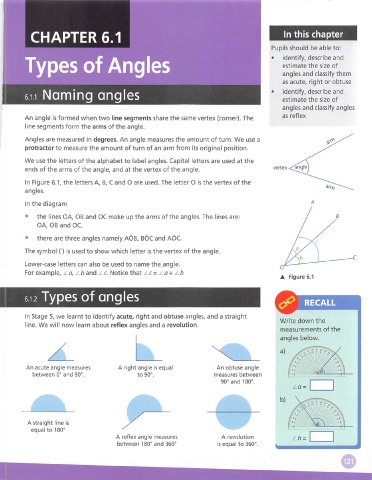
         We use the letters of the alphabet to label angles. Capital letters are used at the
         ends of the arms of the angle, and at the vertex of the angle.                  vertex <;angle
         In Figure 6.1, the letters A, B, C and 0 are used. The letter O is the vertex of the
         angles.

         In the diagram
         •  the lines OA, OB and OC make up the arms of the angles. The lines are:
             OA, OB and OC

         •  there are three angles namely AOB, BOC and AOC.
         The symbol (") is used to show which letter is the vertex of the angle.

         Lower-case letters can also be used to name the angle.
         For example, ^a, /.band Ac. Notice that Ac= Aa+ Ah
                                                                                            s  Figure 6.1

           1.2 Types of angles                                                            ^ RECALL


         In Stage 5, we learnt to identify acute, right and obtuse angles, and a straight
                                                                                            Write down the
         line. We will now learn about reflex angles and a revolution.
                                                                                            measurements of the
                                                                                            angles below.


         An acute angle measures       A right angle is equal          An obtuse angle
            between 0® and 90°.              to 90°.                  measures between
                                                                        90° and 180°.


          A straight line is
           equal to 180°
                                       A reflex angle measures           A revolution
                                       between 180° and 360°           is equal to 360°

