


Page 237 - Math Smart - 7
P. 237
In this chapter

                                                                                         Pupils should be able to:
                                                                                        •      recognise line and
                                                                                             rotational symmetry in
                                                                                             2D shapes and patterns
                                                                                        •  identify the order of
                                                                                            rotational symmetry
              Line of symmetry
                                                                                        •     draw lines of symmetry
                                                                                            and complete patterns
                                                                                            with two lines of
       i        Investigate!                                                                symmetry
        m

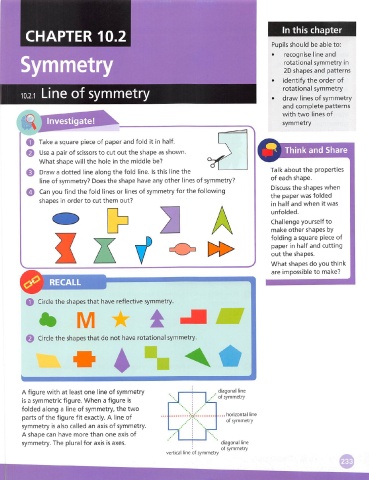
         o    Take a square piece of paper and fold it in half.

         e    Use a pair of scissors to cut out the shape as shown.
              What shape will the hole in the middle be?

         0    Draw a dotted line along the fold line. Is this line the                  Talk about the properties
              line of symmetry? Does the shape have any other lines of symmetry?        of each shape.
                                                                                         Discuss the shapes when
         o    Can you find the fold lines or lines of symmetry for the following
                                                                                        the paper was folded
              shapes in order to cut them out?
                                                                                        in half and when it was
                                                                                         unfolded.
                                                    X                                    Challenge yourself to
                                                                                         make other shapes by
                                                                                        folding a square piece of
                                                                                         paper in half and cutting
                                                                                         out the shapes.
                                                                                         What shapes do you think
                                                                                         are impossible to make?
       ^ RECALL


         O Circle the shapes that have reflective symmetry.


            * M                                 i


         Q Circle the shapes that do not have rotational symmetry.


                                     4


        A figure with at least one line of symmetry                    diagonal line
                                                                       of symmetry
        is a symmetric figure. When a figure is
        folded along a line of symmetry, the two
                                                                          horizontal line
        parts of the figure fit exactly. A line of
                                                                          of symmetry
        symmetry is also called an axis of symmetry.
        A shape can have more than one axis of
        symmetry. The plural for axis is axes.                          diagonal line
                                                                        of symmetry
                                                       vertical line of symmetry

