


Page 462 - Math Smart - 7
P. 462
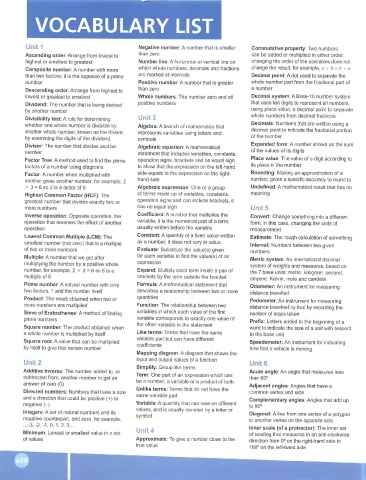
VOCABULARY LIST


         Unit1                                Negative number: A number that is smaller  Commutative property: Two numbers
         Ascending order: Arrange from lowest to  than zero                        can be added or multiplied in either order;
         highest or smallest to greatest      Number line: A horizontal or vertical line on  changing the order of the operators does not
         Composite number: A number with more  which whole numbers, decimals and fractions  change the result, for example, a x h = h x a
         than two factors; It is the opposite of a prime  are marked at intervals  Decimal point: A dot used to separate the
         number                               Positive number: A number that Is greater  whole number part from the fractional part of
         Descending order: Arrange from highest to  than zero                     a number
         lowest or greatest to smallest       Whole numbers: The number zero and all  Decimal system: A Base-10 number system
         Dividend: The number that is being divided  positive numbers             that uses ten digits to represent all numbers,
         by another number                                                         using place value, a decimal point to separate
                                                                                   whole numbers from decimal fractions
         Divisibility test: A rule for determining  Unit 3
         whether one whole number is divisible by  Algebra: A branch of mathematics that  Decimals: Numbers that are written using a
         another whole number, known as the divisor,  represents variables using letters and  decimal point to indicate the fractional portion
         by examining the digits of the dividend.  symbols                        of the number
                                                                                  Expanded form: A number shown as the sum
         Divisor; The number that divides another  Algebraic equation: A mathematical
                                                                                  of the values of its digits
         number                               statement that Includes variables, constants,
         Factor Tree: A method used to find the prime  operation signs, brackets and an equal sign  Place value: The value of a digit according to
         factors of a number using diagrams   to show that the expression on the left-hand  its place in the number
         Factor: A number when multiplied with  side equals to the expression on the right-  Rounding: Making an approximation of a
         another gives another number, for example, 2  hand side                  number, given a specific accuracy to round to
         X 3 = 6 so 2 is a factor of 6        Algebraic expression: One or a group  Undefined: A mathematical result that has no
         Highest Common Factor (HCF): The     of terms made up of variables, constants,  meaning
         greatest number that divides exactly two or  operation signs and can include brackets; it
                                              has no equal sign
         more numbers                                                             Unit 5
         Inverse operation: Opposite operation, the  Coefficient: A number that multiplies the  Convert: Change something into a different
         operation that reverses the effect of another  variable: it is the numerical part of a term,  form, in this case, changing the units of
                                              usually written before the variable
         operation                                                                measurement
         Lowest Common Multiple (LCM): The   Constant: A quantity of a fixed value written  Estimate: The rough calculation of something
         smallest number (not zero) that is a multiple  as a number; it does not vary in value
                                                                                  Interval: Numbers between two given
         of two or more numbers              Evaluate: Substitute the value{s) given
                                                                                  numbers
         Multiple: A number that we get after  for each variable to find the value(s) of an  Metric system: An international decimal
         multiplying the number by a positive whole  expression
                                                                                  system of weights and measures, based on
         number, for example, 2x3 = 6 so 6 Is a  Expand: Multiply each term inside a pair of
                                                                                  the 7 base units: metre, kilogram, second,
         multiple of 6                       brackets by the term outside the bracket
                                                                                  ampere, Kelvin, mole and candela
         Prime number: A natural number with only  Formula: A mathematical statement that
                                                                                  Odometer: An instrument for measuring
         two factors, 1 and the number itself  describes a relationship between two or more
                                                                                  distance travelled
                                             quantities
         Product; The result obtained when two or
                                                                                  Pedometer: An instrument for measuring
         more numbers are multiplied         Function: The relationship between two
                                                                                  distance travelled by foot by recording the
         Sieve of Eratosthenes: A method of finding  variables in which each value of the first  number of steps taken
         prime numbers                       variable corresponds to exactly one value of
                                                                                  Prefix: Letters added to the beginning of a
                                             the other variable in the statement
         Square number: The product obtained when                                 word to indicate the size of a unit with respect
         a whole number is multiplied by itself  Like terms: Terms that have the same  to the base unit
                                             variable part but can have different
         Square root: A value that can be multiplied                              Speedometer: An instrument for indicating
                                             coefficients
         by itself to give that certain number                                    how fast a vehicle is moving
                                             Mapping diagram: A diagram that shows the
                                             input and output values of a function
         Unit 2                                                                   Unit 6
                                             Simplify: Group like terms
         Additive inverse: The number added to, or                                Acute angle: An angle that measures less
                                             Term: One part of an expression which can
         subtracted from, another number to get an                                than 90°
                                             be a number, a variable or a product of both
         answer of zero (0)
                                                                                  Adjacent angles: Angles that have a
                                             Unlike terms: Terms that do not have the
         Directed numbers: Numbers that have a size                               common vertex and side
                                             same variable part
         and a direction that could be positive (+) or                            Complementary angles: Angles that add up
         negative (-)                        Variable: A quantity that can take on different  to 90°
                                             values, and is usually denoted by a letter or
         Integers: A set of natural numbers and its                               Diagonal: A line from one vertex of a polygon
                                             symbol
         negative counterpart, and zero, for example,                             to another vertex on the opposite side
        ...-3, -2,-1,0,1,2, 3...
                                                                                  Inner scale (of a protractor): The inner set
                                             Unit 4
         Minimum: Lowest or smallest value in a set
                                                                                  of reading that measures in an anti-clockwise
        of values                            Approximate: To give a number close to the  direction from 0° on the right-hand side to
                                             true value
                                                                                  180° on the left-hand side

