


Page 58 - Math Smart - 7
P. 58
<p                                    Expanding algebraic expressions

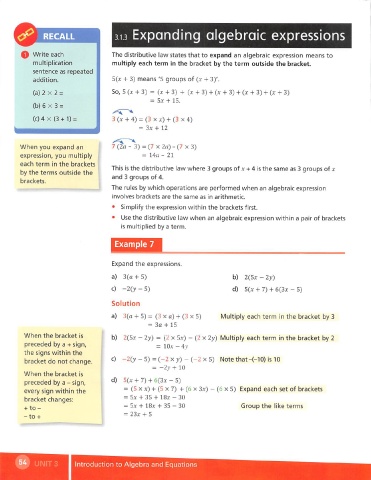
        Q Write each                 The distributive law states that to expand an algebraic expression means to
            multiplication           multiply each term in the bracket by the term outside the bracket.
            sentence as repeated
                                     5(Ar + 3) means '5 groups of (x + 3)'.
            addition.
           (a) 2 X 2 =               So, 5 (a: + 3) = (x + 3) + (x + 3) + (x + 3) + (X + 3) + (a: + 3)
                                                 = 5x + 15.
           (b) 6 X 3 =

           (c)4x(3 + l) =            3 (x + 4) = (3 X x) + (3 X 4)
                                              = 3x + 12

        When you expand an           7 (2a - 3) = (7 X 2a) -(7x3)
       expression, you multiply                = 14a - 21
       each term in the brackets
                                     This is the distributive law where 3 groups of x + 4 is the same as 3 groups of x
        by the terms outside the
                                     and 3 groups of 4.
        brackets.
                                     The rules by which operations are performed when an algebraic expression
                                     involves brackets are the same as in arithmetic.
                                     •  Simplify the expression within the brackets first.
                                     • Use the distributive law when an algebraic expression within a pair of brackets
                                        is multiplied by a term.

                                      Example 7


                                     Expand the expressions.

                                     a)  3(a + 5)                           b)  2(5x-2y)
                                     c)  -2(y-5)                            d) 5(x + 7) + 6(3x - 5)

                                     Solution

                                     a)  3(a + 5) = (3 X a) + (3 X 5)    Multiply each term in the bracket by 3
                                                 = 3a + 15
         When the bracket is         b)  2(5x - 2y) = (2 x 5x) - (2 x 2y) Multiply each term in the bracket by 2
         preceded by a + sign,                     = lOx - 4y
         the signs within the
                                     c)  -2(y-5)=(-2xy)-(-2x5) Note that-(-10) is 10
         bracket do not change.
                                                  = -2y + ia
         When the bracket is
                                     d)  5(x + 7) + 6(3x - 5)
         preceded by a - sign,
                                         = (5 X x) + (5 X 7) + (6 X 3x) -(6x5) Expand each set of brackets
         every sign within the
         bracket changes:                = 5x + 35 + 18x — 30
                                         = 5x + 18x + 35 - 30                  Group the like terms
         + to -
                                                 5
                                         = 23x +
         -to +


            UNITS        Introduction to Algebra and Equations

