


Page 24 - downmagaz.com
P. 24
INSIGHT CAR-FREE CITIES


         The road reimagined


         Cities are starting to experiment with banning cars from their streets.
         It is a move that makes a lot of sense, says Alice Klein


         IN DOWNTOWN Madrid, the             and diesel cars also produce        commutes by car contribute to          When Paris held its fourth
         reign of cars is coming to an end.   greenhouse gases – chiefly         physical inactivity, one of the      annual car-free day on
         Starting next month, the city       carbon dioxide – that contribute    biggest public health problems of    16 September, levels of nitrogen
         centre will be shut off to all cars,   to climate change.               the 21st century. Exposure to traffic   dioxide pollution near major
         barring electric vehicles, those      On top of this, road crashes      noise, meanwhile, has been linked    roads dropped by as much as
         belonging to residents and a few    injure 78 million people and        with depression in adults and        41 per cent and noise levels fell by
         other exceptions.                   kill more than 1 million others     attention problems in children.      up to 5 per cent. In Brussels, soot
           Several other capital cities are   globally every year. Long             In other words, cars are bad      levels decreased by 80 per cent
         also clamping down on cars. Oslo                                        news. Now, evidence is mounting      when it banned cars on the same
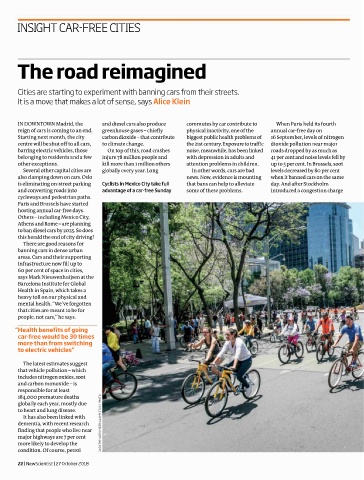
         is eliminating on-street parking    Cyclists in Mexico City take full   that bans can help to alleviate      day. And after Stockholm
         and converting roads into           advantage of a car-free Sunday      some of these problems.              introduced a congestion charge
         cycleways and pedestrian paths.
         Paris and Brussels have started
         hosting annual car-free days.
         Others – including Mexico City,
         Athens and Rome – are planning
         to ban diesel cars by 2025. So does
         this herald the end of city driving?
           There are good reasons for
         banning cars in dense urban
         areas. Cars and their supporting
         infrastructure now fill up to
         60 per cent of space in cities,
         says Mark Nieuwenhuijsen at the
         Barcelona Institute for Global
         Health in Spain, which takes a
         heavy toll on our physical and
         mental health. “We’ve forgotten
         that cities are meant to be for
         people, not cars,” he says.

        “Health benefits of going
         car-free would be 30 times
         more than from switching
         to electric vehicles”


           The latest estimates suggest
         that vehicle pollution – which
         includes nitrogen oxides, soot
         and carbon monoxide – is
         responsible for at least
         184,000 premature deaths
         globally each year, mostly due
         to heart and lung disease.
           It has also been linked with
         dementia, with recent research      DOROTHY ALEXANDER/ALAMY STOCK PHOTO
         finding that people who live near
         major highways are 7 per cent
         more likely to develop the
         condition. Of course, petrol


         22 | NewScientist | 27 October 2018

