


Page 48 - downmagaz.com
P. 48
CULTURE


         The scandal of scholarship


         Expect some righteous anger as a new film exposes an unexpected con, says Graham Lawton


                                             margins of some 37 per cent – nice   have risen faster than inflation for  research bodies, which together
         Paywall: The business of scholarship,   for shareholders and the industry.  years. Publishers sell discounted   hand out €18 billion a year,
         directed by Jason Schmitt, can be     These fat margins are built on    “bundles” of subs to libraries, but   unveiled a radical plan: from
         viewed at paywallthemovie.com
                                             publicly funded research and free   remove content without notice.       2020, research they fund must
         TWO minutes into this riveting      scientific labour. The research,    They also ask institutions to sign   be published in an open access
         documentary, there’s a moment       paper writing, peer review and      non-disclosure agreements about      journal, making it instantly
         of cinematic genius. Just as the    journal editing are done by         prices, ostensibly in return for a   available to everyone for free.
         story is getting into its stride,   scientists funded by taxpayers.     discount, so nobody knows what       Will this finally change the game?
         THUD – down comes a paywall         Yet the resulting research papers   anyone else pays and collective        The evolving story is told
         and a voice says: “We are sorry,    somehow end up the intellectual                                          mainly through talking heads,
         you do not have the credentials to   property of the publisher.        “ Scientists in poor (and             yet, amazingly, the passion and
         access this documentary. Please       To add insult to injury, subs and  even rich) countries can’t          eloquence of the interviewees
         see payment options below.”         tolls are largely paid by university  get at research they need,         plus punchy editing keeps it
           You’re going to have to shell     libraries, funded by… taxpayers.    while publishers get rich”           exciting. And the film ends with
         out $39.95 to keep watching. Of     It’s not as if there’s competition,                                      a real bang as we meet Alexandra
         course, you don’t. The paywall      either. Scientists need access to all   bargaining is impossible. Many   Elbakyan, the “pirate queen” of
         is fake and, after a few agonising   journals, making them a licence    scientists in poor countries (but    scientific publishing, who runs
         seconds, the film rolls on. But     to print money for the publishers.  sometimes also in rich ones) can’t   Sci-Hub. This website makes
         its impact is real, a mixture of    And to advance their careers, they   get access to research they need,   around 70 million paywalled
         “WTF?” and “How dare they!”         must publish in high-impact         while the publishers just get rich.  research papers freely and easily
           This is precisely the reaction    journals, mostly run on the            There is another model, open      available. Elbakyan has been
         film-maker Jason Schmitt is         toll-access model.                  access, but 20 years of insurgency   sued by Elsevier and others, and
         aiming for, and what academics        There’s worse. For no reason      have failed to smash the system.     is a fugitive from justice so her
         feel when butting up against        other than price gouging, costs     Last month, however, 13 European  interview was a real coup. When
         paywalls that demand money in                                                                                Schmitt asks her opinion of
         exchange for allowing them to                                                                                Elsevier (Sci-Hub’s most pirated
         read the latest research in their                                                                            publisher), she delivers the film’s
         field. This research is likely to                                                                            coup de grâce with her arch reply:
         have been paid for by all of us,                                                                             “I like their slogan ‘making
         but has ended up out of reach                                                                                uncommon knowledge common’
         behind a barrier.                                                                                            very much, but as far as I can tell,
           The story of how this happened                                                                             Elsevier has not mastered this job
         is the stuff of Paywall, a movie                                                                             well. Sci-Hub is helping them to
         whose unpromising material is                                                                                fulfil their mission.”
         unexpectedly spun into gold as                                                                                 If I have any criticism of the
         we are carried on a rising tide                                                                              movie, it is that it fails to capture
         of astonishment and righteous                                                                                the publishers’ story – if only to
         anger. By the end, you will be                                                                               let them hang themselves. It also
         convinced scholarly publishing                                                                               focuses too much on Elsevier,
         is one of the greatest cons ever.                                                                            which, says Schmitt, declined
           It is worth billions to                                                                                    to take part. This focus unfairly
         publishers, who charge people to                                                                             demonises one company and
         read their journals through fees or                                                                          lets others off the hook. For
         subscriptions. But neither comes                                                                             balance, you should know that
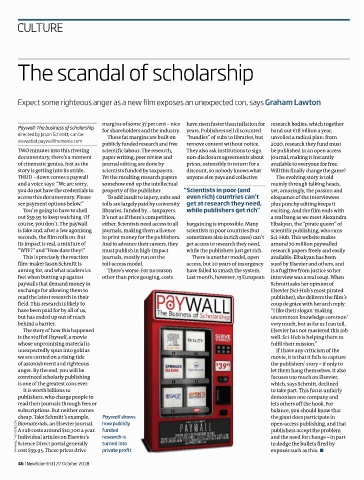
         cheap. Take Schmitt’s example,      Paywall shows                                                            the giant does participate in
        PAYWALLTHEMOVIE.COM  A sub costs around $10,700 a year.   funded                                              publishers accept the problem
                                             how publicly
         Biomaterials, an Elsevier journal.
                                                                                                                      open-access publishing, and that
         Individual articles on Elsevier’s
                                                                                                                      and the need for change – in part
                                             research is
                                                                                                                      to dodge the bullets fired by
                                             turned into
         Science Direct portal generally
         cost $39.95. These prices drive
         46 | NewScientist | 27 October 2018  private profit                                                          exposés such as this.  ■

