


Page 56 - downmagaz.com
P. 56
LETTERS                                                                       letters@newscientist.com                @newscientist                newscientist


         At present, it is the organisation   pathological (15 September, p 24).  It would be interesting to know     being genetically engineered to
         that gets prosecuted, so the          His assertion that higher voter   if any measurements of electron      spread sterility in their species
         taxpayers or patients end up        turnouts may lead back to “a more   densities for that period exist.     (13 October, p 24). Couldn’t we
         paying the fines.                   familiar political landscape” is                                         instead engineer a mosquito not
                                             questionable. It was contradicted   Electric cars may clean              to carry the plasmodium that
         Shrimp’s breakout punch             in the UK referendum on EU          air, but choke roads                 causes malaria? That would still
         doesn’t hold water                  membership, which engaged                                                allow the species to be preserved.
                                             3 million more voters than the      From Rosemary Sharples,
         From Rob Gunnett,                   previous general election.          Penshurst, New South Wales,          The editor writes:
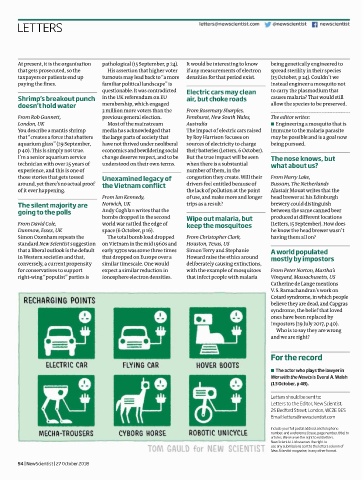
         London, UK                            Most of the mainstream            Australia                            Q  Engineering a mosquito that is
         You describe a mantis shrimp        media has acknowledged that         The impact of electric cars raised   immune to the malaria parasite
         that “creates a force that shatters   the large parts of society that    by Roy Harrison focuses on          may be possible and is a goal now
         aquarium glass” (29 September,      have not thrived under neoliberal   sources of electricity to charge     being pursued.
         p 40). This is simply not true.     economics and bewildering social    their batteries (Letters, 6 October).
         I’m a senior aquarium service       change deserve respect, and to be   But the true impact will be seen     The nose knows, but
         technician with over 25 years of    understood on their own terms.      when there is a substantial          what about us?
         experience, and this is one of                                          number of them, in the
         those stories that gets tossed      Unexamined legacy of                congestion they create. Will their   From Harry Lake,
         around, yet there’s no actual proof   the Vietnam conflict              drivers feel entitled because of     Bussum, The Netherlands
         of it ever happening.                                                   the lack of pollution at the point   Alastair Mouat writes that the
                                             From Ian Kennedy,                   of use, and make more and longer     head brewer at his Edinburgh
         The silent majority are             Norwich, UK                         trips as a result?                   brewery could distinguish
         going to the polls                  Andy Coghlan writes that the                                             between the same canned beer
                                             bombs dropped in the second         Wipe out malaria, but                produced at different locations
         From David Cole,                    world war rattled the edge of       keep the mosquitoes                  (Letters, 15 September). How does
         Dunmow, Essex, UK                   space (6 October, p 16).                                                 he know the head brewer wasn’t
         Simon Oxenham repeats the             The total bomb load dropped       From Christopher Clark,              having them all on?
         standard New Scientist suggestion   on Vietnam in the mid 1960s and     Houston, Texas, US
         that a liberal outlook is the default   early 1970s was some three times   Simon Terry and Stephanie         A world populated
         in Western societies and that,      that dropped on Europe over a       Howard raise the ethics around       mostly by impostors
         conversely, a current propensity    similar timescale. One would        deliberately causing extinctions,
         for conservatives to support        expect a similar reduction in       with the example of mosquitoes       From Peter Norton, Martha’s
         right-wing “populist” parties is    ionosphere electron densities.      that infect people with malaria      Vineyard, Massachusetts, US
                                                                                                                      Catherine de Lange mentions
                                                                                                                      V. S. Ramachandran’s work on
                                                                                                                      Cotard syndrome, in which people
                                                                                                                      believe they are dead, and Capgras
                                                                                                                      syndrome, the belief that loved
                                                                                                                      ones have been replaced by
                                                                                                                      impostors (29 July 2017, p 40).
                                                                                                                        Who is to say they are wrong
                                                                                                                      and we are right?


                                                                                                                      For the record


                                                                                                                      Q  The actor who plays the lawyer in
                                                                                                                      War with the Newts is Everal A. Walsh
                                                                                                                      (13 October, p 48).

                                                                                                                      Letters should be sent to:
                                                                                                                      Letters to the Editor, New Scientist,
                                                                                                                      25 Bedford Street, London, WC2E 9ES
                                                                                                                      Email: letters@newscientist.com


                                                                                                                      Include your full postal address and telephone
                                                                                                                      number, and a reference (issue, page number, title) to
                                                                                                                      articles. We reserve the right to edit letters.
                                                                                                                      New Scientist Ltd reserves the right to
                                                                                                                      use any submissions sent to the letters column of
                                                                                                                      New Scientist magazine, in any other format.

         54 | NewScientist | 27 October 2018

