


Page 9 - downmagaz.com
P. 9
For daily news stories, visit newscientist.com/news


       Salty Martian

       water may hold

       oxygen for life


       THE atmosphere of Mars may not
       contain much oxygen, but that doesn’t
       necessarily mean the planet itself
       lacks the stuff. A calculation of how
       much oxygen could be dissolved in
       salty Martian groundwater shows
       that the dusty world may be hiding
       an abundance of oxygen under its
       surface – potentially enough to
       support life.
          We know Mars has oxygen on its
       surface, which is why it looks red:
       iron in Martian dust mixes with
       oxygen to create rust.
          Vlada Stamenkovic´  at NASA’s Jet                                                                                                             DANIEL VIÑÉ GARCIA/GETTY
       Propulsion Laboratory in California
       and his colleagues calculated how
       much oxygen could be dissolved in
       brines just under the planet’s surface.                                                                      western United States,” he says.
          They found that, under particularly   Australia’s Grand                                                      Beyond extending the Grand
       cold conditions, certain types of                                                                            Canyon’s reach across the
       brines could hold just as much      Canyon connection                                                        Pacific and into the southern
       oxygen as seawater does on Earth.                                                                            hemisphere, uniting the
       This would be enough for microbes                                                                            Tasmanian rocks with those in
       and even simple animals like sponges                                                                         North America helps to solve an
       to survive (Nature Geoscience,       Lucas Joel                          didn’t look a lot like similarly    ancient geological jigsaw puzzle.
       doi. org/ cv2v).                                                         aged rocks nearby.”                    About a billion years ago, all
          But we aren’t entirely certain    THE Grand Canyon in Arizona           Mulder and his colleagues         of Earth’s continental plates
       there are liquid brines on Mars.     has a bizarre Antipodean link.      have now found that the rocks       formed a single supercontinent
       Despite clues, such as recurring     A chunk of the rock sequence that   contain minerals with the same
       slope lineae – dark lines flowing down   has been sliced through to form   “geochemical fingerprint”        “We concluded that
       hills that appear to be liquid – there   this natural wonder of the world   as those in the Grand Canyon     Tasmania must have
       is no definitive proof on which all   now sits thousands of kilometres   (Geology, doi.org/cv24).            been attached to the
       researchers can agree.               away in Tasmania, Australia.          “We concluded that although       western United States”
          “There have been various different    To peer into the Grand Canyon   it’s now on the opposite side
       claims for where we may or may not   is to behold, in its rock layers, a   of the planet, Tasmania must      called Rodinia. But working
       have seen evidence for these brines   record of Earth’s distant past. The   have been attached to the        out exactly how today’s
       existing,” says Kirsten Siebach at Rice   oldest layers at the bottom date                                   continents would once have
       University in Texas. “Small amounts   back more than 1.5 billion years.                                      fitted together to form Rodinia
       of brines would be possible, but we    It is some of the most ancient                                        is no simple task given how long
       aren’t sure that they’re really there.”  layers in the sequence that                                         ago it existed. The Tasmanian
          Even if Mars does have oxygen-rich   interest Jack Mulder, a geologist                                    discovery provides a clue because
       brine, that’s no guarantee of life,   at Australia’s Monash University.                                      it is clear evidence that North
       says Robin Wordsworth at Harvard     He thinks these rocks – which are                                       America and Australia were linked
       University. “It’s two sides of the coin   between about 1.1 and 1.2 billion                                  together at the time.
       in a way,” he says. “If you want     years old – look just like similarly                                       “Jack’s paper shows that
       respiration, oxygen is good, but too   ancient rocks in Tasmania.                                            Tasmania holds the key to tying
       much oxidation can be bad for life.”   The Tasmanian rocks in                                                together the tectonic geography of
          Compounds like hydrogen peroxide   question have always seemed a                                          the time,” says Alan Collins at the
       can damage cells, which may be       bit out of place, he says. “They                                        University of Adelaide, Australia.
       particularly bad for primitive life forms                                                                    “It’s really a good link and tie that
       that don’t have that many cells to   These Tasmanian rocks were once                                        JACK MULDER  allows us to build full plate models
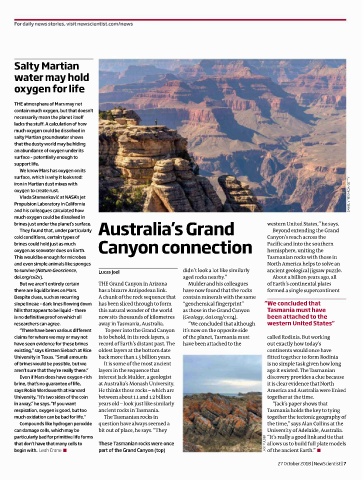
       begin with.  Leah Crane  ■           part of the Grand Canyon (top)                                          of the ancient Earth.”  ■

                                                                                                                         27 October 2018 | NewScientist | 7

