


Page 358 - Basic Principles of Textile Coloration
P. 358
BIFUNCTIONAL REACTIVE DYES 347

stripping. Complete colour discharge is often possible by treatment with alkaline
sodium hydrosulphite solution followed by hypochlorite. Before such treatments,
complexed metals should be removed using EDTA.

16.4 BIFUNCTIONAL REACTIVE DYES
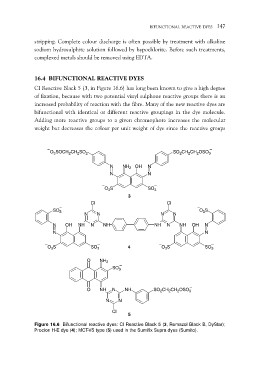
CI Reactive Black 5 (3, in Figure 16.6) has long been known to give a high degree
of fixation, because with two potential vinyl sulphone reactive groups there is an
increased probability of reaction with the fibre. Many of the new reactive dyes are
bifunctional with identical or different reactive groupings in the dye molecule.
Adding more reactive groups to a given chromophore increases the molecular
weight but decreases the colour per unit weight of dye since the reactive groups

O3SOCH2CH2SO2                          SO2CH2CH2OSO3

                    N NH2 OH N
                    NN

                    O3S      SO3

                          3

               Cl                     Cl
                                  NN
SO3  NN                                        O3S

N OH NH N NH                    NH N      NH OH N
N                                                         N

O3S            SO3        4       O3S          SO3

     O NH2
                     SO3

     O NH N NH                  SO2CH2CH2OSO3
                 NN

                                                   Cl 5

Figure 16.6 Bifunctional reactive dyes: CI Reactive Black 5 (3, Remazol Black B, DyStar);
Procion H-E dye (4); MCT-VS type (5) used in the Sumifix Supra dyes (Sumito).

