


Page 429 - Basic Principles of Textile Coloration
P. 429
418 UNION DYEING

attack on the reactive dyes already present on the cotton. Some types of disperse
dyes can be cleared by alkaline scouring (Section 15.7.4) so that the reactive dyes
are not affected. This process only takes 7–8 h.

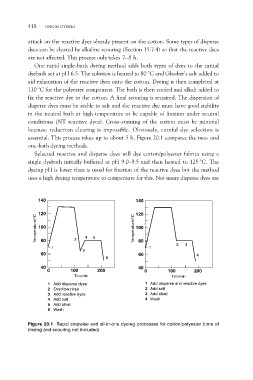
   One rapid single-bath dyeing method adds both types of dyes to the initial
dyebath set at pH 6.5. The solution is heated to 80 °C and Glauber’s salt added to
aid exhaustion of the reactive dyes onto the cotton. Dyeing is then completed at
130 °C for the polyester component. The bath is then cooled and alkali added to
fix the reactive dye to the cotton. A final scouring is required. The dispersion of
disperse dyes must be stable to salt and the reactive dye must have good stability
in the neutral bath at high temperature or be capable of fixation under neutral
conditions (NT reactive dyes). Cross-staining of the cotton must be minimal
because reduction clearing is impossible. Obviously, careful dye selection is
essential. This process takes up to about 5 h. Figure 20.1 compares the two- and
one-bath dyeing methods.

   Selected reactive and disperse dyes will dye cotton/polyester fabrics using a
single dyebath initially buffered at pH 9.0–9.5 and then heated to 125 °C. The
dyeing pH is lower than is usual for fixation of the reactive dyes but the method
uses a high dyeing temperature to compensate for this. Not many disperse dyes are

140                                                                                       140

120                                                                                       120
Temperature/oC
                                                                          Temperature/oC100100

80         2 45                                                                           80         23
        1        3                                                                                1

60                             6                                                          60                      4

40         100            200                                                             40         100          200
    0                                                                                         0
              Time/min                                                                                  Time/min

     1 Add disperse dyes                                                                       1 Add disperse and reactive dyes
     2 Overflow rinse                                                                          2 Add salt
     3 Add reactive dyes                                                                       3 Add alkali
     4 Add salt                                                                                4 Wash
     5 Add alkali
     6 Wash

Figure 20.1 Rapid stepwise and all-in-one dyeing processes for cotton/polyester (time of
rinsing and scouring not included)

