


Page 12 - Elementary_Linear_Algebra_with_Applications_Anton__9_edition
P. 12
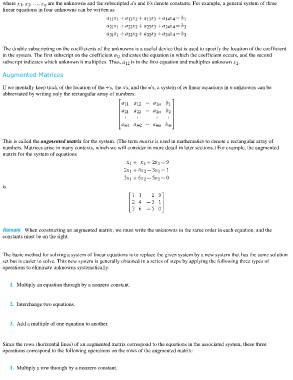
where , , …, are the unknowns and the subscripted a's and b's denote constants. For example, a general system of three
linear equations in four unknowns can be written as

The double subscripting on the coefficients of the unknowns is a useful device that is used to specify the location of the coefficient
in the system. The first subscript on the coefficient indicates the equation in which the coefficient occurs, and the second
subscript indicates which unknown it multiplies. Thus, is in the first equation and multiplies unknown .

Augmented Matrices

If we mentally keep track of the location of the +'s, the x's, and the ='s, a system of m linear equations in n unknowns can be
abbreviated by writing only the rectangular array of numbers:

This is called the augmented matrix for the system. (The term matrix is used in mathematics to denote a rectangular array of
numbers. Matrices arise in many contexts, which we will consider in more detail in later sections.) For example, the augmented
matrix for the system of equations

is

Remark When constructing an augmented matrix, we must write the unknowns in the same order in each equation, and the
constants must be on the right.
The basic method for solving a system of linear equations is to replace the given system by a new system that has the same solution
set but is easier to solve. This new system is generally obtained in a series of steps by applying the following three types of
operations to eliminate unknowns systematically:

    1. Multiply an equation through by a nonzero constant.

    2. Interchange two equations.

    3. Add a multiple of one equation to another.

Since the rows (horizontal lines) of an augmented matrix correspond to the equations in the associated system, these three
operations correspond to the following operations on the rows of the augmented matrix:

    1. Multiply a row through by a nonzero constant.

