


Page 167 - Elementary_Linear_Algebra_with_Applications_Anton__9_edition
P. 167
2.4                                   There is a combinatorial view of determinants that actually predates matrices. In
                                      this section we explore this connection.
A COMBINATORIAL
APPROACH TO
DETERMINANTS

There is another way to approach determinants that complements the cofactor expansion approach. It is based on permutations.

            DEFINITION                        is an arrangement of these integers in some order without omissions or

A permutation of the set of integers
repetitions.

EXAMPLE 1 Permutations of Three Integers
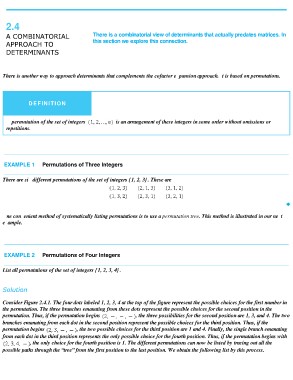
There are six different permutations of the set of integers {1, 2, 3}. These are

One convenient method of systematically listing permutations is to use a permutation tree. This method is illustrated in our next
example.

EXAMPLE 2 Permutations of Four Integers
List all permutations of the set of integers {1, 2, 3, 4}.

Solution

Consider Figure 2.4.1. The four dots labeled 1, 2, 3, 4 at the top of the figure represent the possible choices for the first number in

the permutation. The three branches emanating from these dots represent the possible choices for the second position in the

permutation. Thus, if the permutation begins                , the three possibilities for the second position are 1, 3, and 4. The two

branches emanating from each dot in the second position represent the possible choices for the third position. Thus, if the

permutation begins  , the two possible choices for the third position are 1 and 4. Finally, the single branch emanating

from each dot in the third position represents the only possible choice for the fourth position. Thus, if the permutation begins with

          , the only choice for the fourth position is 1. The different permutations can now be listed by tracing out all the

possible paths through the “tree” from the first position to the last position. We obtain the following list by this process.

