


Page 212 - Elementary_Linear_Algebra_with_Applications_Anton__9_edition
P. 212
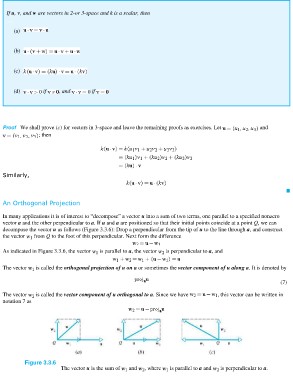
If u, v, and w are vectors in 2-or 3-space and k is a scalar, then
   (a)

(b)

(c)

(d)         if , and  if

Proof We shall prove (c) for vectors in 3-space and leave the remaining proofs as exercises. Let  and
                   ; then

Similarly,

An Orthogonal Projection

In many applications it is of interest to “decompose” a vector u into a sum of two terms, one parallel to a specified nonzero
vector a and the other perpendicular to a. If u and a are positioned so that their initial points coincide at a point Q, we can
decompose the vector u as follows (Figure 3.3.6): Drop a perpendicular from the tip of u to the line through a, and construct
the vector from Q to the foot of this perpendicular. Next form the difference

As indicated in Figure 3.3.6, the vector is parallel to a, the vector is perpendicular to a, and

The vector is called the orthogonal projection of u on a or sometimes the vector component of u along a. It is denoted by

The vector is called the vector component of u orthogonal to a. Since we have                                   (7)
notation 7 as                                                                  , this vector can be written in

     Figure 3.3.6
                        The vector u is the sum of and , where is parallel to a and is perpendicular to a.

