


Page 262 - Elementary_Linear_Algebra_with_Applications_Anton__9_edition
P. 262
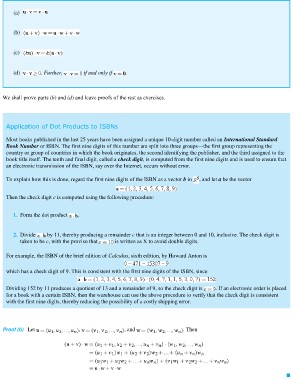
(a)
     (b)
     (c)
     (d) . Further, if and only if .

We shall prove parts (b) and (d) and leave proofs of the rest as exercises.

Application of Dot Products to ISBNs

Most books published in the last 25 years have been assigned a unique 10-digit number called an International Standard
Book Number or ISBN. The first nine digits of this number are split into three groups—the first group representing the
country or group of countries in which the book originates, the second identifying the publisher, and the third assigned to the
book title itself. The tenth and final digit, called a check digit, is computed from the first nine digits and is used to ensure that
an electronic transmission of the ISBN, say over the Internet, occurs without error.

To explain how this is done, regard the first nine digits of the ISBN as a vector b in , and let a be the vector

Then the check digit c is computed using the following procedure:

   1. Form the dot product .

2. Divide by 11, thereby producing a remainder c that is an integer between 0 and 10, inclusive. The check digit is

taken to be c, with the proviso that  is written as X to avoid double digits.

For example, the ISBN of the brief edition of Calculus, sixth edition, by Howard Anton is

which has a check digit of 9. This is consistent with the first nine digits of the ISBN, since

Dividing 152 by 11 produces a quotient of 13 and a remainder of 9, so the check digit is . If an electronic order is placed
for a book with a certain ISBN, then the warehouse can use the above procedure to verify that the check digit is consistent
with the first nine digits, thereby reducing the possibility of a costly shipping error.

Proof (b) Let , , and                                                        . Then

