


Page 4 - Elementary_Linear_Algebra_with_Applications_Anton__9_edition
P. 4
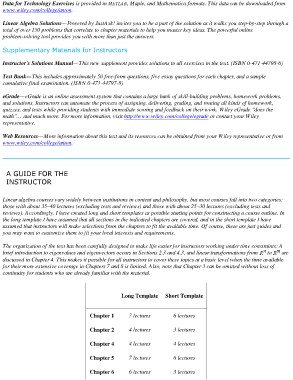
Data for Technology Exercises is provided in MATLAB, Maple, and Mathematica formats. This data can be downloaded from
www.wiley.com/college/anton.

Linear Algebra Solutions—Powered by JustAsk! invites you to be a part of the solution as it walks you step-by-step through a
total of over 150 problems that correlate to chapter materials to help you master key ideas. The powerful online
problem-solving tool provides you with more than just the answers.

Supplementary Materials for Instructors

Instructor's Solutions Manual—This new supplement provides solutions to all exercises in the text. (ISBN 0-471-44798-6)

Test Bank—This includes approximately 50 free-form questions, five essay questions for each chapter, and a sample
cumulative final examination. (ISBN 0-471-44797-8)

eGrade—eGrade is an online assessment system that contains a large bank of skill-building problems, homework problems,
and solutions. Instructors can automate the process of assigning, delivering, grading, and routing all kinds of homework,
quizzes, and tests while providing students with immediate scoring and feedback on their work. Wiley eGrade “does the
math”… and much more. For more information, visit http://www.wiley.com/college/egrade or contact your Wiley
representative.

Web Resources—More information about this text and its resources can be obtained from your Wiley representative or from
www.wiley.com/college/anton.

 A GUIDE FOR THE
 INSTRUCTOR

Linear algebra courses vary widely between institutions in content and philosophy, but most courses fall into two categories:
those with about 35–40 lectures (excluding tests and reviews) and those with about 25–30 lectures (excluding tests and
reviews). Accordingly, I have created long and short templates as possible starting points for constructing a course outline. In
the long template I have assumed that all sections in the indicated chapters are covered, and in the short template I have
assumed that instructors will make selections from the chapters to fit the available time. Of course, these are just guides and
you may want to customize them to fit your local interests and requirements.

The organization of the text has been carefully designed to make life easier for instructors working under time constraints: A
brief introduction to eigenvalues and eigenvectors occurs in Sections 2.3 and 4.3, and linear transformations from to are
discussed in Chapter 4. This makes it possible for all instructors to cover these topics at a basic level when the time available
for their more extensive coverage in Chapters 7 and 8 is limited. Also, note that Chapter 3 can be omitted without loss of
continuity for students who are already familiar with the material.

           Long Template Short Template

Chapter 1  7 lectures  6 lectures
Chapter 2  4 lectures  3 lectures
Chapter 4  4 lectures  4 lectures
Chapter 5  7 lectures  6 lectures
Chapter 6  6 lectures  3 lectures

