


Page 533 - Elementary_Linear_Algebra_with_Applications_Anton__9_edition
P. 533
form an orthonormal set.

   Is there a weighted Euclidean inner product on for which the vectors (1, 2) and ( 3, −1) form an orthonormal set?
8. Justify your answer.

Prove: If Q is an orthogonal matrix, then each entry of Q is the same as its cofactor if                and is the negative of its

9. cofactor if  .

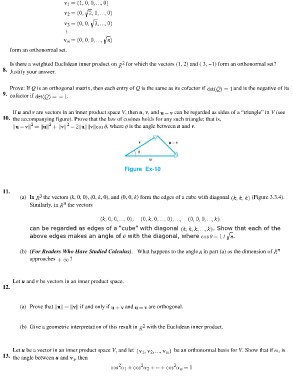
If u and v are vectors in an inner product space V, then u, v, and    can be regarded as sides of a “triangle” in V (see

10. the accompanying figure). Prove that the law of cosines holds for any such triangle; that is,

                   , where is the angle between u and v.

                                                        Figure Ex-10

11.                                                                                                     (Figure 3.3.4).
         (a) In the vectors (k, 0, 0), (0, k, 0), and (0, 0, k) form the edges of a cube with diagonal

              Similarly, in the vectors

can be regarded as edges of a “cube” with diagonal                                        . Show that each of the
above edges makes an angle of with the diagonal, where                                              .

(b) (For Readers Who Have Studied Calculus). What happens to the angle in part (a) as the dimension of
     approaches ?

     Let u and v be vectors in an inner product space.
12.

(a) Prove that     if and only if and are orthogonal.

(b) Give a geometric interpretation of this result in with the Euclidean inner product.

     Let u be a vector in an inner product space V, and let           be an orthonormal basis for V. Show that if is
13. the angle between u and , then

