


Page 723 - Elementary_Linear_Algebra_with_Applications_Anton__9_edition
P. 723
EXAMPLE 4 Three Conics
From Figure 9.6.1, the equation

matches the form of an ellipse with  and . Thus the ellipse is in standard position, intersecting the x-axis at (−2, 0)

and (2, 0) and intersecting the y-axis at (0, −3) and (0, 3).

The equation  can be rewritten as                              , which is of the form     with ,

. Its graph is thus a hyperbola in standard position intersecting the y-axis at  and   .

The equation  can be rewritten as                              , which is of the form with . Since , its graph

is a parabola in standard position opening downward.

Significance of the Cross-Product Term

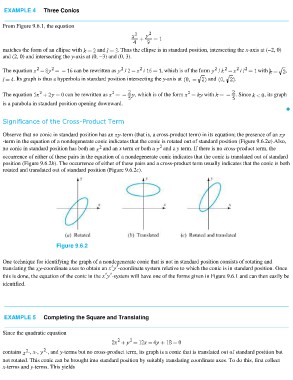
Observe that no conic in standard position has an -term (that is, a cross-product term) in its equation; the presence of an
-term in the equation of a nondegenerate conic indicates that the conic is rotated out of standard position (Figure 9.6.2a).Also,
no conic in standard position has both an and an x term or both a and a y term. If there is no cross-product term, the
occurrence of either of these pairs in the equation of a nondegenerate conic indicates that the conic is translated out of standard
position (Figure 9.6.2b). The occurrence of either of these pairs and a cross-product term usually indicates that the conic is both
rotated and translated out of standard position (Figure 9.6.2c).

                            Figure 9.6.2

One technique for identifying the graph of a nondegenerate conic that is not in standard position consists of rotating and
translating the -coordinate axes to obtain an -coordinate system relative to which the conic is in standard position. Once
this is done, the equation of the conic in the -system will have one of the forms given in Figure 9.6.1 and can then easily be
identified.

EXAMPLE 5 Completing the Square and Translating

Since the quadratic equation

contains -, x-, -, and y-terms but no cross-product term, its graph is a conic that is translated out of standard position but
not rotated. This conic can be brought into standard position by suitably translating coordinate axes. To do this, first collect
x-terms and y-terms. This yields

