


Page 793 - Elementary_Linear_Algebra_with_Applications_Anton__9_edition
P. 793
We now show how DeMoivre's formula can be used to obtain roots of complex numbers. If n is a positive integer and z is any
complex number, then we define an nth root of z to be any complex number w that satisfies the equation

                                                                                                                                                     (8)

We denote an nth root of z by . If , then we can derive formulas for the nth roots of z as follows. Let
If we assume that w satisfies 8, then it follows from 6 that

                                                                                                                        (9)

Comparing the moduli of the two sides, we see that  or

where denotes the real positive nth root of r. Moreover, in order to have the equalities              and in 9,
the angles and must either be equal or differ by a multiple of . That is,

Thus the values of  that satisfy 8 are given by

Although there are infinitely many values of k, it can be shown (see Exercise 16) that    , 1, 2, …,  produce distinct

values of w satisfying 8 but all other choices of k yield duplicates of these. Therefore, there are exactly n different nth roots of

                    , and these are given by

                                                                                                         (10)

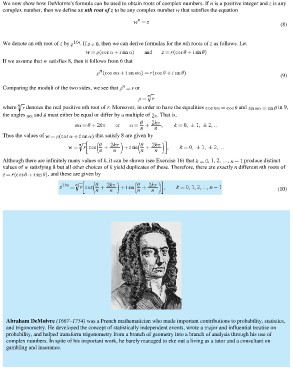
Abraham DeMoivre (1667–1754) was a French mathematician who made important contributions to probability, statistics,
and trigonometry. He developed the concept of statistically independent events, wrote a major and influential treatise on
probability, and helped transform trigonometry from a branch of geometry into a branch of analysis through his use of
complex numbers. In spite of his important work, he barely managed to eke out a living as a tutor and a consultant on
gambling and insurance.

