


Page 906 - Elementary_Linear_Algebra_with_Applications_Anton__9_edition
P. 906
11.7                     In this section we introduce matrix representations of relations among members
                         of a set. We use matrix arithmetic to analyze these relationships.
GRAPH THEORY

                         Prerequisites: Matrix Addition and Multiplication

Relations among Members of a Set

There are countless examples of sets with finitely many members in which some relation exists among members of the set. For
example, the set could consist of a collection of people, animals, countries, companies, sports teams, or cities; and the relation
between two members, A and B, of such a set could be that person A dominates person B, animal A feeds on animal B, country A
militarily supports country B, company A sells its product to company B, sports team A consistently beats sports team B, or city A
has a direct airline flight to city B.

We shall now show how the theory of directed graphs can be used to mathematically model relations such as those in the
preceding examples.

Directed Graphs

A directed graph is a finite set of elements,         together with a finite collection of ordered pairs                    of distinct

elements of this set, with no ordered pair being repeated. The elements of the set are called vertices, and the ordered pairs are

called directed edges, of the directed graph. We use the notation  (which is read “ is connected to ”) to indicate that

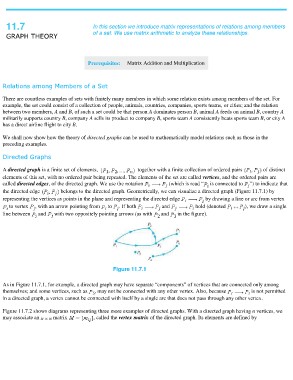
the directed edge  belongs to the directed graph. Geometrically, we can visualize a directed graph (Figure 11.7.1) by

representing the vertices as points in the plane and representing the directed edge  by drawing a line or arc from vertex

to vertex , with an arrow pointing from to . If both               and               hold (denoted        ), we draw a single

line between and with two oppositely pointing arrows (as with and in the figure).

                                               Figure 11.7.1

As in Figure 11.7.1, for example, a directed graph may have separate “components” of vertices that are connected only among

themselves; and some vertices, such as , may not be connected with any other vertex. Also, because        is not permitted

in a directed graph, a vertex cannot be connected with itself by a single arc that does not pass through any other vertex.

Figure 11.7.2 shows diagrams representing three more examples of directed graphs. With a directed graph having n vertices, we

may associate an matrix  , called the vertex matrix of the directed graph. Its elements are defined by

