


Page 914 - Elementary_Linear_Algebra_with_Applications_Anton__9_edition
P. 914
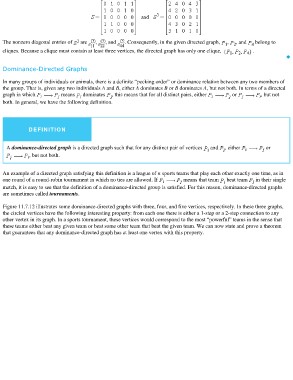
The nonzero diagonal entries of are , , and . Consequently, in the given directed graph, , , and belong to

cliques. Because a clique must contain at least three vertices, the directed graph has only one clique,  .

Dominance-Directed Graphs

In many groups of individuals or animals, there is a definite “pecking order” or dominance relation between any two members of

the group. That is, given any two individuals A and B, either A dominates B or B dominates A, but not both. In terms of a directed

graph in which  means dominates , this means that for all distinct pairs, either                         or , but not

both. In general, we have the following definition.

DEFINITION

A dominance-directed graph is a directed graph such that for any distinct pair of vertices and , either     or
            , but not both.

An example of a directed graph satisfying this definition is a league of n sports teams that play each other exactly one time, as in

one round of a round-robin tournament in which no ties are allowed. If  means that team beat team in their single

match, it is easy to see that the definition of a dominance-directed group is satisfied. For this reason, dominance-directed graphs

are sometimes called tournaments.

Figure 11.7.12 illustrates some dominance-directed graphs with three, four, and five vertices, respectively. In these three graphs,
the circled vertices have the following interesting property: from each one there is either a 1-step or a 2-step connection to any
other vertex in its graph. In a sports tournament, these vertices would correspond to the most “powerful” teams in the sense that
these teams either beat any given team or beat some other team that beat the given team. We can now state and prove a theorem
that guarantees that any dominance-directed graph has at least one vertex with this property.

