


Page 231 - SCIENCE DLP T6 SK (SEMAKAN 2017)
P. 231
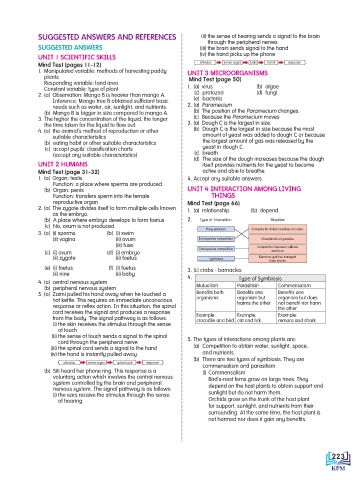
SUGGESTED ANSWERS AND REFERENCES                 (ii) the sense of hearing sends a signal to the brain
                                                               through the peripheral nerves
             SUGGESTED ANSWERS                               (iii) the brain sends signal to the hand
                                                             (iv) the hand picks up the phone
             UNIT 1 SCIENTIFIC SKILLS
             Mind Test (pages 11-12)                         stimulus  sense organ  brain   hand   response
             1.  Manipulated variable: methods of harvesting paddy   UNIT 3 MICROORGANISMS
              plants                                      Mind Test (page 50)
              Responding variable: land area
              Constant variable: type of plant           1.  (a)  virus       (b)  algae
             2. (a)  Observation: Mango B is heavier than mango A.   (c)  protozoa  (d)  fungi
                 Inference: Mango tree B obtained sufficient basic   (e)  bacteria
                 needs such as water, air, sunlight, and nutrients.  2. (a)  Paramecium
              (b)  Mango B is bigger in size compared to mango A.  3. (b)  The position of the Paramecium changes.
             3. The higher the concentration of the liquid, the longer   4. (c)  Because the Paramecium moves
              the time taken for the liquid to flow out.  3. (a)  Dough C is the largest in size.
             4. (a)  the animal’s method of reproduction or other   (b)  Dough C is the largest in size because the most
                 suitable characteristics                     amount of yeast was added to dough C or because
              (b)  eating habit or other suitable characteristics  the largest amount of gas was released by the
               (c)  accept pupils’ classification charts                             yeast in dough C.
                 (accept any suitable characteristics)     (c)  breath
                                                           (d)  The size of the dough increases because the dough
             UNIT 2 HUMANS                                    itself provides nutrients for the yeast to become
             Mind Test (page 31-32)                           active and able to breathe.
             1.  (a)  Organ: testis                     3. 4. Accept any suitable answers.
                 Function: a place where sperms are produced.
              (b)  Organ: penis                          UNIT 4 INTERACTION AMONG LIVING
                 Function: transfers sperm into the female       THINGS
                 reproductive organ                      Mind Test (page 66)
             2. (a)  The zygote divides itself to form multiple cells known   1.  (a)  relationship  (b)  depend
                 as the embryo.                                              (c)
              (b)  A place where embryo develops to form foetus  2.    Type of Interaction  (d)   Situation
               (c)  No, ovum is not produced.
                                                                             Compete for limited number of mates.
                                                               Prey-predator  (e)
             3. (a)  (i) sperms   (b)  (i) swim                              (f)
                 (ii) vagina        (ii) ovum                Intraspecies competition  Cheetahs hunt gazelles
                                    (iii) fuse                                Competition between vultures
                                                             Interspecies competition
               (c)  (i) ovum     (d)  (i) embryo                                   and lions
                 (ii) zygote        (ii) foetus                 Symbiosis      Remoras get free transport
                                                                                  from sharks
              (e)  (i) foetus     (f)  (i) foetus        3. (c) crabs - barnacles
                 (ii) nine          (ii) baby
                                                         4.              Type of Symbiosis
             4. (a)  central nervous system
              (b)  peripheral nervous system                Mutualism   Parasitism   Commensalism
             5. (a)  Zaimi pulled his hand away when he touched a   Benefits both   Benefits one   Benefits one
                 hot kettle. This requires an immediate unconscious   organisms  organism but   organism but does
                                                                        harms the other
                                                                                     not benefit nor harm
                 response or reflex action. In this situation, the spinal            the other
                 cord receives the signal and produces a response   Example:   Example:                 Example:
                 from the body. The signal pathway is as follows.  crocodile and bird cat and tick  remora and shark
                 (i) the skin receives the stimulus through the sense
                   of touch
                 (ii) the sense of touch sends a signal to the spinal
                   cord through the peripheral nerve     5. The types of interactions among plants are:
                (iii) the spinal cord sends a signal to the hand  (a)  Competition to obtain water, sunlight, space,
                (iv) the hand is instantly pulled away        and nutrients.
                                                           (b)  There are two types of symbiosis. They are
                    stimulus  sense organ  spinal cord  response
                                                              commensalism and parasitism.
              (b)  Siti heard her phone ring. This response is a   (i) Commensalism
                 voluntary action which involves the central nervous   Bird’s-nest ferns grow on large trees. They
                 system controlled by the brain and peripheral
                 nervous system. The signal pathway is as follows:  depend on the host plants to obtain support and
                 (i) the ears receive the stimulus through the sense   sunlight but do not harm them.
                   of hearing                                   Orchids grow on the trunk of the host plant
                                                                for support, sunlight, and nutrients from their
                                                                surrounding. At the same time, the host plant is
                                                                not harmed nor does it gain any benefits.


                                                                                                     223

