


Page 70 - Computing Book 7
P. 70
Programming the Computer (Python)                                                    Class 7


               Checking for Bugs:

               A software bug is a coding error that causes an unexpected defect in a computer program. In other
               words, if a program does not perform as intended, it is most likely because of a bug.

               There are bugs in software due to unclear or constantly changing requirements, software
               complexity, programming errors, timelines, errors in bug tracking, communication gap,
               documentation errors, deviation from standards etc.

               There are two types of errors/bug in python or any other programming language.

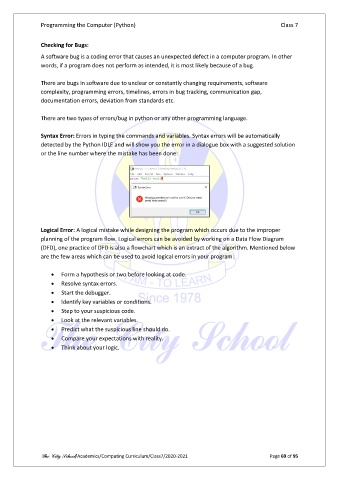
               Syntax Error: Errors in typing the commands and variables. Syntax errors will be automatically
               detected by the Python IDLE and will show you the error in a dialogue box with a suggested solution
               or the line number where the mistake has been done:


               Logical Error: A logical mistake while designing the program which occurs due to the improper
               planning of the program flow. Logical errors can be avoided by working on a Data Flow Diagram
               (DFD), one practice of DFD is also a flowchart which is an extract of the algorithm. Mentioned below
               are the few areas which can be used to avoid logical errors in your program:

                   •  Form a hypothesis or two before looking at code.
                   •  Resolve syntax errors.
                   •  Start the debugger.
                   •  Identify key variables or conditions.
                   •  Step to your suspicious code.
                   •  Look at the relevant variables.
                   •  Predict what the suspicious line should do.
                   •  Compare your expectations with reality.
                   •  Think about your logic.


               The City School/Academics/Computing Curriculum/Class7/2020-2021                  Page 69 of 95

