


Page 141 - Career Readiness Catalog
P. 141
MODULES (1-4 weeks)
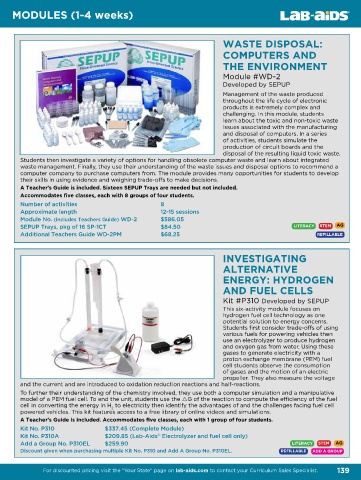
WASTE DISPOSAL:
COMPUTERS AND
THE ENVIRONMENT
Module #WD-2
Developed by SEPUP
Management of the waste produced
throughout the life cycle of electronic
products is extremely complex and
challenging . In this module, students
learn about the toxic and non-toxic waste
issues associated with the manufacturing
and disposal of computers . In a series
of activities, students simulate the
production of circuit boards and the
disposal of the resulting liquid toxic waste .
Students then investigate a variety of options for handling obsolete computer waste and learn about integrated
waste management . Finally, they use their understanding of the waste issues and disposal options to recommend a
computer company to purchase computers from . The module provides many opportunities for students to develop
their skills in using evidence and weighing trade-offs to make decisions .
A Teacher’s Guide is included. Sixteen SEPUP Trays are needed but not included.
Accommodates five classes, each with 8 groups of four students.
Number of activities 8
Approximate length 12-15 sessions
Module No. (includes Teachers Guide) WD-2 $586.05
SEPUP Trays, pkg of 16 SP-1CT $84.50 LITERACY STEM AG
Additional Teachers Guide WD-2PM $68.25 REFILLABLE
INVESTIGATING
ALTERNATIVE
ENERGY: HYDROGEN
AND FUEL CELLS
Kit #P310 Developed by SEPUP
This six-activity module focuses on
hydrogen fuel cell technology as one
potential solution to energy concerns .
Students first consider trade-offs of using
various fuels for powering vehicles then
use an electrolyzer to produce hydrogen
and oxygen gas from water . Using these
gases to generate electricity with a
proton exchange membrane (PEM) fuel
cell students observe the consumption
of gases and the motion of an electric
propeller . They also measure the voltage
and the current and are introduced to oxidation reduction reactions and half-reactions .
To further their understanding of the chemistry involved, they use both a computer simulation and a manipulative
model of a PEM fuel cell . To end the unit, students use the G of the reaction to compute the efficiency of the fuel
cell in converting the energy in H to electricity then identify the advantages of and the challenges facing fuel cell
2
powered vehicles . This kit features access to a free library of online videos and simulations .
A Teacher’s Guide is included. Accommodates five classes, each with 1 group of four students.
Kit No. P310 $337.45 (Complete Module)
®
Kit No. P310A $209.85 (Lab-Aids Electrolyzer and fuel cell only)
Add a Group No. P310EL $259.90 LITERACY STEM AG
Discount given when purchasing multiple Kit No. P310 and Add A Group No. P310EL. REFILLABLE ADD A GROUP
For discounted pricing visit the “Your State” page on lab-aids.com to contact your Curriculum Sales Specialist. 139

