


Page 143 - Career Readiness Catalog
P. 143
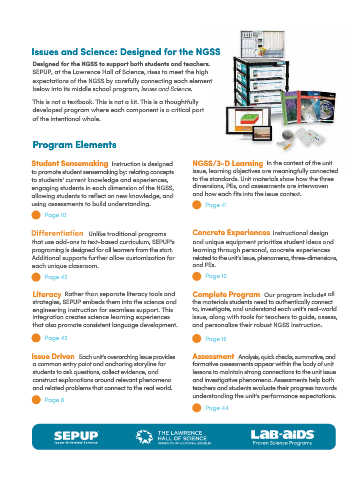
Issues and Science: Designed for the NGSS

           Designed for the NGSS to support both students and teachers.
           SEPUP, at the Lawrence Hall of Science, rises to meet the high
           expectations of the NGSS by carefully connecting each element
           below into its middle school program, Issues and Science.
           This is not a textbook. This is not a kit. This is a thoughtfully
           developed program where each component is a critical part
           of the intentional whole.


           Program Elements


              Student Sensemaking    Instruction is designed   NGSS/3-D Learning      In the context of the unit


           to promote student sensemaking by: relating concepts   issue, learning objectives are meaningfully connected
           to students' current knowledge and experiences,    to the standards. Unit materials show how the three
           engaging students in each dimension of the NGSS,   dimensions, PEs, and assessments are interwoven
           allowing students to reflect on new knowledge, and   and how each fits into the issue context.
           using assessments to build understanding.              Page 41
               Page 10


                                   Unlike traditional programs     Concrete Experiences  Instructional design

           that use add-ons to text-based curriculum, SEPUP's   and unique equipment prioritize student ideas and
           programing is designed for all learners from the start.    learning through personal, concrete experiences
           Additional supports further allow customization for   related to the unit’s issue, phenomena, three-dimensions,
           each unique classroom.                             and PEs.
               Page 42                                            Page 10

             Literacy                                         Complete Program           program includes all
                                                                       Our
                          Rather than separate literacy tools and
           strategies, SEPUP embeds them into the science and   the materials students need to authentically connect
           engineering instruction for seamless support. This   to, investigate, and understand each unit's real-world
           integration creates science learning experiences     issue, along with tools for teachers to guide, assess,
           that also promote consistent language development.   and personalize their robust NGSS instruction.
               Page 43                                            Page 16


           Issue Driven   Each unit's overarching issue provides     Assessment      Analysis, quick checks, summative, and


           a common entry point and anchoring storyline for   formative assessments appear within the body of unit
           students to ask questions, collect evidence, and   lessons to maintain strong connections to the unit issue
           construct explanations around relevant phenomena   and investigative phenomena. Assessments help both
           and related problems that connect to the real world.   teachers and students evaluate their progress towards
                                                              understanding the unit's performance expectations.
               Page 8
                                                                  Page 44

