


Page 188 - Fisika Terapan for Engineers and Scientists
P. 188
388                                CHAPTER 12  Rotation of a Rigid Body


                    initial angular velocity? Through what total angle does the  12.5 Kinetic Energy of Rotation;
                    spool rotate while slowing to a stop? What is the angular  Moment of Iner tia
                    acceleration during this motion?
                 23. If you lift the lid of a washing machine during the rapid  30. Find the moment of inertia of an orange of mass 300 g and
                    spin–dry cycle, the cycle stops (for safety), typically after 5.0  diameter 9.0 cm. Treat the orange as a uniform sphere.
                    revolutions. If the clothes are spinning at 6.0 rev/s initially,  31. The original Ferris wheel built by George Ferris (see
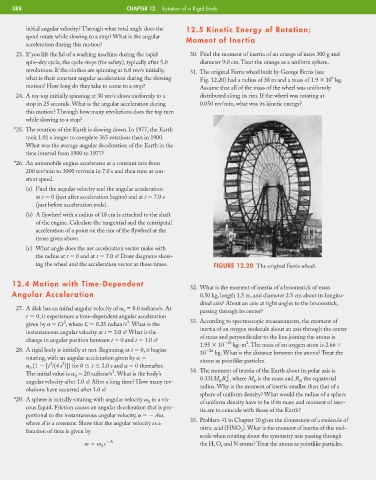
                    what is their constant angular acceleration during the slowing  Fig. 12.20) had a radius of 38 m and a mass of 1.9   10 kg.
                                                                                                                 6
                    motion? How long do they take to come to a stop?     Assume that all of the mass of the wheel was uniformly
                 24. A toy top initially spinning at 30 rev/s slows uniformly to a  distributed along its rim. If the wheel was rotating at
                    stop in 25 seconds. What is the angular acceleration during  0.050 rev/min, what was its kinetic energy?
                    this motion? Through how many revolutions does the top turn
                    while slowing to a stop?
                 *25. The rotation of the Earth is slowing down. In 1977, the Earth
                    took 1.01 s longer to complete 365 rotations than in 1900.
                    What was the average angular deceleration of the Earth in the
                    time interval from 1900 to 1977?
                 *26. An automobile engine accelerates at a constant rate from
                    200 rev/min to 3000 rev/min in 7.0 s and then runs at con-
                    stant speed.
                    (a) Find the angular velocity and the angular acceleration
                       at t   0 (just after acceleration begins) and at t   7.0 s
                       (just before acceleration ends).
                    (b) A flywheel with a radius of 18 cm is attached to the shaft
                       of the engine. Calculate the tangential and the centripetal
                       acceleration of a point on the rim of the flywheel at the
                       times given above.
                    (c) What angle does the net acceleration vector make with
                       the radius at t   0 and at t   7.0 s? Draw diagrams show-
                       ing the wheel and the acceleration vector at these times.  FIGURE 12.20 The original Ferris wheel.

                12.4 Motion with Time-Dependent
                                                                      32. What is the moment of inertia of a broomstick of mass
                Angular Acceleration                                     0.50 kg, length 1.5 m, and diameter 2.5 cm about its longitu-
                                                                         dinal axis? About an axis at right angles to the broomstick,
                 27. A disk has an initial angular velocity of     8.0 radians/s. At  passing through its center?
                                                  0
                    t   0, it experiences a time-dependent angular acceleration
                                2
                                                   4
                    given by     Ct , where C   0.25 radian/s . What is the  33. According to spectroscopic measurements, the moment of
                                                                         inertia of an oxygen molecule about an axis through the center
                    instantaneous angular velocity at t   3.0 s? What is the
                                                                         of mass and perpendicular to the line joining the atoms is
                    change in angular position between t   0 and t   1.0 s?      46    2
                                                                         1.95   10  kg m . The mass of an oxygen atom is 2.66
                 28. A rigid body is initially at rest. Beginning at t   0, it begins   26
                                                                         10   kg. What is the distance between the atoms? Treat the
                    rotating, with an angular acceleration given by      atoms as pointlike particles.
                               2
                            2
                      {1   [t  (4 s )]} for 0   t   2.0 s and     0 thereafter.
                     0
                                              2
                    The initial value is     20 radians/s . What is the body’s  34. The moment of inertia of the Earth about its polar axis is
                                   0
                                                                                 2
                                                                               E
                    angular velocity after 1.0 s? After a long time? How many rev-  0.331M R , where M is the mass and R the equatorial
                                                                                                       E
                                                                                         E
                                                                                 E
                                                                         radius. Why is the moment of inertia smaller than that of a
                    olutions have occurred after 1.0 s?
                                                                         sphere of uniform density? What would the radius of a sphere
                 *29. A sphere is initially rotating with angular velocity   in a vis-  of uniform density have to be if its mass and moment of iner-
                                                         0
                    cous liquid. Friction causes an angular deceleration that is pro-
                                                                         tia are to coincide with those of the Earth?
                    portional to the instantaneous angular velocity,      A ,
                                                                      35. Problem 41 in Chapter 10 gives the dimensions of a molecule of
                    where A is a constant. Show that the angular velocity as a
                                                                         nitric acid (HNO ). What is the moment of inertia of this mol-
                    function of time is given by                                     3
                                                                         ecule when rotating about the symmetry axis passing through
                                            e  At                        the H, O, and N atoms? Treat the atoms as pointlike particles.
                                           0

