


Page 183 - Fisika Terapan for Engineers and Scientists
P. 183
12.5  Kinetic Energy of Rotation; Moment of Inertia                383


                                           1   2   1    2      l  2
                                            Ml       Ml 	 M a b                   (12.39)
                                           3       12          2
                     which is identically true.
                        Note that it is a corollary of Eq. (12.38) that the moment of inertia about an axis
                     passing through the center of mass is always smaller than that about any other paral-
                     lel axis.
                        Table 12.3 lists the moments of inertia of a variety of rigid bodies about an axis
                     through their center of mass; all the bodies are assumed to have uniform density.


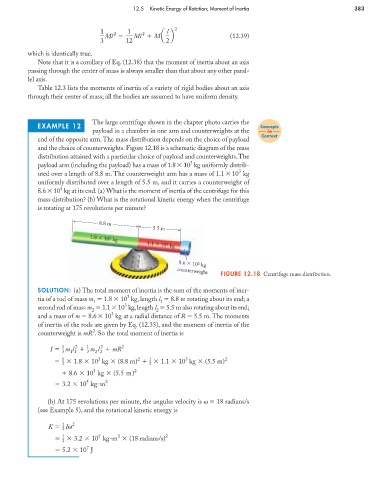
                                        The large centrifuge shown in the chapter photo carries the
                        EXAMPLE 12                                                         Concepts
                                        payload in a chamber in one arm and counterweights at the  in
                                                                                            Context
                        end of the opposite arm.The mass distribution depends on the choice of payload
                        and the choice of counterweights. Figure 12.18 is a schematic diagram of the mass
                        distribution attained with a particular choice of payload and counterweights.The
                                                                      3
                        payload arm (including the payload) has a mass of 1.8  10 kg uniformly distrib-
                                                                                     3
                        uted over a length of 8.8 m. The counterweight arm has a mass of 1.1   10 kg
                        uniformly distributed over a length of 5.5 m, and it carries a counterweight of
                               3
                        8.6   10 kg at its end. (a) What is the moment of inertia of the centrifuge for this
                        mass distribution? (b) What is the rotational kinetic energy when the centrifuge
                        is rotating at 175 revolutions per minute?


                                          8.8 m
                                                           5 5 m
                                        1.8   10 3
                                               kg
                                                         1.1   10 3
                                                                kg
                                                                   8.6   10 3
                                                                          kg
                                                                  counterweight
                                                                               FIGURE 12.18 Centrifuge mass distribution.
                        SOLUTION: (a) The total moment of inertia is the sum of the moments of iner-
                                                   3
                        tia of a rod of mass m   1.8   10 kg, length l   8.8 m rotating about its end; a
                                         1
                                                             1
                                                  3
                        second rod of mass m   1.1  10 kg, length l   5.5 m also rotating about its end;
                                                            2
                                        2
                                              3
                        and a mass of m   8.6   10 kg at a radial distance of R   5.5 m. The moments
                        of inertia of the rods are given by Eq. (12.35), and the moment of inertia of the
                                        2
                        counterweight is mR . So the total moment of inertia is
                                   2
                                           2
                               1
                                       1
                            I   m l 	 m l 	 mR   2
                                       3
                               3
                                         2 2
                                  1 1
                                                      2
                                                                     3
                               1
                                                          1
                                          3
                                 1.8   10  kg   (8.8 m) 	   1.1   10  kg   (5.5 m) 2
                               3                          3
                                         3
                                	 8.6   10   kg   (5.5 m) 2
                                       5
                               3.2   10   kg  m 2
                           (b) At 175 revolutions per minute, the angular velocity is     18 radians/s
                        (see Example 5), and the rotational kinetic energy is
                               1
                             K   I  2
                               2
                                          5
                                                2
                               1
                                 3.2   10  kg  m   (18 radians/s) 2
                               2
                                       7
                               5.2   10   J

