


Page 218 - NAVAL SCIENCE 3 TEXTBOOK
P. 218
224      NAVAL  SKILLS


                            MANEUVERING  BOARD


                                                         •
               ~,  ,  ,  ,  ,  ,  .  ,   R     ,  '.   ,   ,   "I!
                                    .  \
                               >( •.. 0.•... ' ....•..  " .••••.  " ...... "        .. ,
                                  ':":,-:'~              •                            """'.-, .... , .. ,"".,..., .... , ......  "", .....
                                  .   "-     r                                        _  ....  _  ......  "'.;>''''''''t'.'''~"O''
                                                                                      0(11,,1  .... ~.,""  'Gt"t.  ~.'''''''' • ...,.</
                                                                                      toPQGfW· ... C  tt.t(.  * .. -',''C' ....  OC  201"
                                                                                      ",. C"",,_
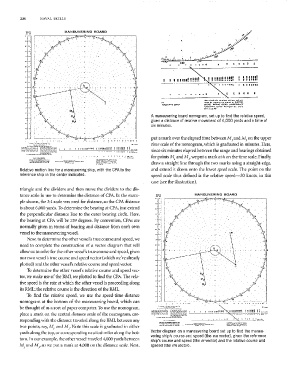
                                                                A maneuvering board  nomogram,  set up to find the relative speed,
                                                                given  a distance of relative movement of 4,000 yards and a time of
                                                 ,              six minutes.
                                                 -,;P.
                                               ,-
                                            ,  . , . <.  ., ,,' \   put a mark over the elapsed time between 1\1j and 1\J on the upper
                                                                                                        3
                                                    ~
                                                                time scale of the nomogram, which is graduated in minutes. Here,
                                                                since six minutes elapsed between the range and bearings obtained
                                                                for points l\J} and 1\1 , we put a mark at 6 on the time scale. Finally,
                                                                                3
                                                                draw a straight line through the two  marks using a straight -edge,
         Relative motion line for a maneuvering ship, with the CPA to the   and extend it down onto the lower speed scale. The point on the
         reference ship  in the center indicated.               speed scale  thus  defined  is  the  relative  speed-20 knots,  in  this
                                                                case (see the illustration),
         triangle and  the dividers and  then  move the dividers  to  the dis-
         tance scale in use to determine the distance of CPA. In the exam-        MANEUVERING  BOARD
         ple shown, the 2: 1 scale was used for distance, so the CPA distance
         is about 6.000 yards, To determine the bearing at CPA, just extend
                                                                                                         •
                                                                                                        . ~ ..
         the perpendicular distance line to the outer bearing circle. Here,                                ,
                                                                                                          ,
         the bearing at CPA will be 259 degrees, By convention, CPAs are
         normally given  in terms of bearing and distance from  one's own
         vessel to the maneuvering vessel.
            Now, to determine the other vessel's true course and speed, we
         need  to complete the  construction of a vector diagram that will
         allow us to solve for the other vessel's true course and speed, given
         our own vessel's true course and speed vector (which we've already
         plotted) and the other vessel's relative course and speed vector.
            To determine the other vessel's relative course and speed vec-
         tor, we make use of the RML we plotted to find the CPA, The rela-
         tive speed is the rate at which the other vessel is proceeding along
         its RML; the relative course is the direction of the fu'vIL
            To  find  the  relative  speed,  we  use  the  speed-time-distance
         nomogram at the bottom of the maneuvering board, which  can                       "'.            . .... ,'
                                                                                           "
         be thought of as a sort of paper computer. Ib use the nomogram,   ~"-<'" --,,-~.~
         place a mark on the central distance scale of the nomogranl, cor-  ~~~~~2j -~t~~ ~-' -'-.. -~.-~~~" I'll!!!!!!  ~-:·~;-::-m-·-·l-:,~-:::::~ ~.:::
                                                                  ---------~--.--                  ,  ,  ,  • " ••• r=:;"' __
         responding with the distance traveled along the R~\'lL betw-een any
         two points, say, AJ and 1\1 , Note this scale is graduated in either   .   ~~ -~ ~~ ~-~- "~,
                                                                                  ~'''"
                       j      3
         yards along the top, or corresponding nautical miles along the bot-  Vector diagram on a maneuvering board set up to find the  maneu~
                                                                vering ship's course and speed  (the em vector), given  the reference
         tom. In our example, the other vessel traveled 4,000 yards between   ship's course and speed (the ervector) and the relative course and
         AI} and AI ,  so -we put a mark at 4,000 on the distance scale. Nex"t,   speeed  (the rm vector),
                 3

